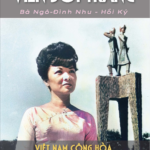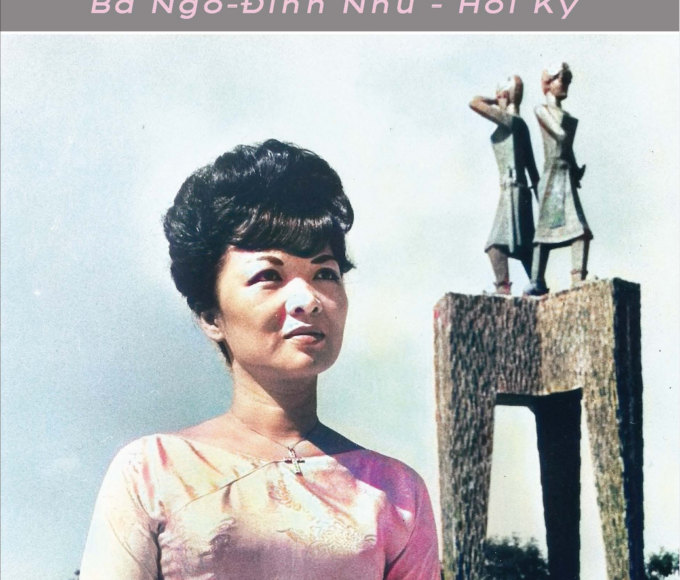
The White Pebble: Mme Nhu’s Memoirs
Foreword
By Tuong Vu, US-Vietnam Research Center
University of Oregon, Eugene, OR
[translated from French, La Republique du Việt-Nam et les Ngô-Đình – Suivi des Memoires póthumes de Madame Ngô-Đình Nhu (Paris: L’Harmattan Editions, 2013)]
(including two parts: Madame Ngô-Dình Nhu, “The White Pebble,” and Ngô-Dình Lệ Quyên, Ngô-Dình Quỳnh & Jacqueline Willemetz, “The Republic of Vietnam and the Ngô-Dình’s”)
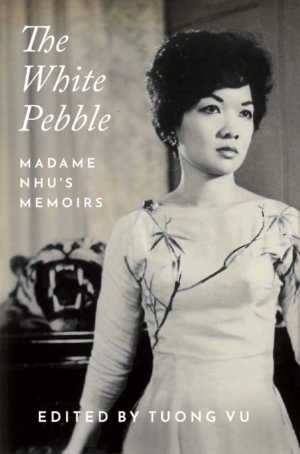
The US-Vietnam Research Center is proud to sponsor the translation from French and publication of Madame Ngô-Đình Nhu (Trần Lệ Xuân)’s posthumous memoir “The White Pebble,” written in the last years of her life. The memoir is accompanied by an essay written by the late Ngô-Đình Lệ Quyên, Ngô-Đình Quỳnh, and Jacqueline Willemetz titled “The Republic of Vietnam and the Ngô-Đình’s.” The late Ngô-Đình Lệ Quyên, who died in 2012, and Ngô-Đình Quỳnh are two of the four children of Ngô-Đình Nhu and Trần Lệ Xuân — the other two, Ngô-Đình Lệ Thuỷ and Ngô-Đình Trác, passed away in 1968 and 2021, respectively. Jacqueline Willemetz is a family friend whose father was a classmate of Ngô-Đình Nhu at the National School of Charters [École Nationale des Chartes].
We are grateful to L’Harmattan Editions for their permission to translate and publish this book. We thank the Ngô-Đình’s family and friends, in particular, Mrs. Jacqueline Willemetz and Mr. Olindo Borsoi who was Ngô-Đình Lệ Quyên’s husband. Mrs. Willemetz and Mr. Borsoi took responsibility for publishing the original book in 2013 after the deaths of Madame Ngô-Đình Nhu in 2011 and Ngô-Đình Lệ Quyên in 2012. Without their generosity to provide the text, images, and other documents, and to grant permission for translation and publication, this book would not have seen the day. Last but not least, we are grateful to Mr. and Mrs. Nguyễn Đức Cường who have supported this project from the beginning. Thanks are due to Mr. Quang L. Phan who provided excellent translations, and Mrs. Maria Cristina de Mariassevich who helped edit the English translation. Finally, we are indebted to Ms. Vũ Hồng Trang who put us into contact with Mr. Olindo Borsoi.
This book provides us with a rare opportunity, more than half a century after the deaths of Ngô-Đình Diệm and Ngô-Đình Nhu, to understand how some members of the Ngô-Đình family, especially Mme. Nhu, viewed themselves and the role of their family in Vietnam’s history.1 That role was no doubt complicated and controversial, but few would question its significance. Regardless of whether one is a fan or a detractor, for the purpose of understanding Vietnam’s modern history, this family is special because it was intertwined with the transition of the country from a French colony & protectorate to an independent and divided nation. It was special because this entire family through President Ngô-Đình Diệm helped shape Vietnam’s modern history in one way or another. It was special because, except the Nguyễn dynasty that began with Emperor Gia Long and extended to Bảo Đại, the last emperor, no other family in modern time has had such an intense involvement in politics and public affairs like the Ngô-Đình’s.
Over two generations, all the male and one female members of this family were involved in politics or served in some public capacity at very high levels: beginning with Ngô-Đình Khả who was a high-ranking mandarin in the Nguyễn court in Huế, followed by his sons Ngô-Đình Khôi who was a provincial chief; Ngô-Đình Thục who was one of the first Vietnamese bishops in French Indochina and later became the archbishop of Vĩnh Long and Huế; Ngô-Đình Diệm who served briefly as a minister in the Nguyễn court in the 1930s, as Prime Minister in 1954-1955, as the founder of the Republic of Vietnam (RVN) and its first President (1955-1963); Ngô-Đình Nhu who directed the Archive and Library in Hanoi before becoming a political organizer, advisor to his brother, President Diệm, and leader of the Cần Lao Revolutionary Party; Ngô-Đình Cẩn, who was advisor to his brother, President Diệm, on matters related to the central region of Vietnam; and Ngô-Đình Luyện who served as the RVN’s Ambassador. Besides the males, Trần Lệ Xuân, commonly known as Madame Ngô-Đình Nhu, was a member of the RVN’s National Assembly (1956-63), the founder of the United Women’s Movement, and an informal “First Lady.”
We do not have as much information about Khôi and Luyện as about their brothers, who stood out thanks to their personal talents and ambitions: Thục was ordained as a priest and sent to study in Rome in his late 20s, then appointed bishop a decade later. Diệm distinguished himself as a provincial chief and gained fame when he resigned as a minister in protest of the French failure to approve political reforms. Nhu was admitted into the National School of Charters [École Nationale des Chartes], a prestigious college in France, contributed significantly to the preservation of the Nguyễn court’s documents, later successfully mobilized domestic political support for his brother to be appointed to the premiership, and served as the brain trust of the Ngô-Đình Diệm government. Swimming against the curent, Mme. Nhu sponsored a progressive family law and raised a national debate on women’s rights and family issues.
Mme. Nhu, or Trần Lệ Xuân, also came from an elite family. Her paternal grandfather was Trần Văn Thông who was the provincial chief of Nam Định. Her father was Trần Văn Chương, a French-trained lawyer who would later become minister of foreign affairs in the Trần Trọng Kim government (April to August 1945) and served as RVN ambassador to the US under Ngô-Đình Diệm (Chương resigned from his post in late 1963 to protest the Diệm government). Her uncle was Trần Văn Đỗ, a medical doctor who twice served as minister of foreign affairs in 1954-55 and 1965-67 under Ngô-Đình Diệm and Nguyễn Cao Kỳ governments, and was deputy prime minister under Prime Minister Phan Huy Quát (1966). Lệ Xuân’s maternal grandmother was a daughter of Emperor Đồng Khánh. She married Lệ Xuân’s grandfather, Thân Trọng Huề, who was minister of war [Binh bộ Thượng thư] at the Huế court. Her mother, Thân Thị Nam Trân, once served as the representative of the RVN at the United Nations as an observer.
From tabloid tales, to memoirs of former officials, to accounts by foreign journalists, much has been written about the rule of President Diệm and the roles played by his family. Only recently did American historians begin to take the ideas and policies of the Diệm government seriously and on its own terms, not as French or American products. Due to space constraint, we will not review this scholarship here. Suffice it to say, the new scholarship has done much to illuminate the politics of the First Republic under President Diệm who appears as a conservative modernizer with a distinct vision and governing style. His government was founded in the most turbulent period of Vietnam’s modern history and he must be credited for creating order out of chaos against all odds. The Republic of Vietnam that he founded was a fledgling nation with limited resources, an extremely diverse society, and a dependent economy with few industries.
The government claimed full sovereignty over all of Vietnam but the North was under the rule of a communist government which made a rival claim over the same territory. The RVN was recognized by nations of the “Free World,” including the US and its allies in Europe, Asia, Africa, and America. Communist North Vietnam had a weaker international position as it was recognized by fewer foreign countries. Still, both Vietnams were not granted membership in the United Nations, and their international legitimacy was limited. For the RVN, part of the territory under its control (in central region and parts of the Mekong delta) had been under communist rule during the Franco-Vietnamese war (1946-1954), and the loyalty of the population to the RVN was suspect.
A few years after the Geneva Accords, with Chinese and Soviet support, North Vietnam began to resume the war against the RVN to unify the country under communism. Hanoi mobilized its supporters left behind in the South, together with those who had earlier regrouped to the North but were now returning with arms and ready for fighting. With American help, the Diệm government successfully stemmed communist advances in 1957-58 and 1960-61. While the war was not won, the military situation was in flux by 1963. Yet the government was unpopular among certain segments of the elite and the population, while refusing to succumb to American pressure for political reform. Amid widespread protests by Buddhists, President Diệm and his brother Nhu were assassinated on November 2nd, 1963 in a military coup backed by the Kennedy administration. However justified, the coup led to four years of political and social chaos, the sharp deterioration of South Vietnam’s military position, and the US’ direct military intervention. It was perhaps the most serious blunder made by the US in the entire course of the Vietnam War, causing the RVN to lose its legitimacy in the eyes of Vietnamese and the world’s people.
Despite the controversies surrounding President Diệm’s rule perceived by many to be authoritarian and nepotistic, it is important for historians and for anyone interested in Vietnamese history to learn more about his family members who played such important roles in his government. How did they see themselves, their country, and their compatriots? How did each member of the family think of others? How did they view the family’s role in history? What brought them so close to each other, and what influence each had on the President? Even though many books have been written about them, this is the first time, after six decades, English and Vietnamese readers can get a glimpse of their thoughts told by none other than themselves.
We can now follow Madame Ngô-Đình Nhu as she narrated important events in her life, from her childhood to her marriage to Mr. Nhu, from her time in Huế during the Franco-Vietnamese war to the happy years of the Diệm government, and from her forced exile to the last days of her life. We learn how difficult her life was at certain points despite her privileged background, how stubborn she was in her belief, how forcefully she could act when the President and her husband were indecisive, how loyal she was to them and to her country, how distressed her life was in exile, and how devoted she was to God in the last years of her life as she wrote her memoir.
Not all the details in the memoir are accurate or objective, nor did she tell us everything she knew or did, but her subjectivity is the very strength of the book. We do not have to believe her entirely, yet we now have an additional source of information and her personal perspective to add to a fascinating yet in many ways tragic chapter of Vietnam’s modern history. The memoir also offers a chance for us to know how she and her children lived their lives in exile after the tragedy. Understandably it took them a long time, if ever, to recover from the shock the deaths of President Diệm and Mr. Nhu brought, which was perhaps why they mostly stayed out of the limelight. Yet their ability to stay true to their characters, and their courage to defend and preserve the family’s honor and dignity in the wake of such a horrendous tragedy, also inspired respect and sympathy.
The essay written by Ngô-Đình Lệ Quyên and Ngô-Đình Quỳnh, and edited by Jacqueline Willemetz, offers how the second generation of the Ngô-Đình family view their role in history. Mrs. Lệ Quyên and Mr. Quỳnh are not historians, and they were still children under the First Republic. Their account is to make the case for the integrity of the Diệm government and his family against their critics. By telling the family’s history alongside that of the Vietnamese nation, they want to demonstrate the sincerity and depth of patriotism in the family. They are on the whole not wrong: even critics of the Diệm government acknowledge that the President was a genuine and incorruptible patriot. Members of the Ngô-Đình family, including the President, have certainly committed many mistakes, but few would question their patriotism, and many would say that the President was a much better leader than his predecessors and successors. He was certainly far more educated and spiritual than the communist rulers in Hanoi.
It is certainly not our purpose here to defend the Ngô-Đình family or the rule of President Diệm. By sponsoring the translation and publication of this book, we only aim to generate interest in and promote education about the history of republican Vietnam. Since 1975, this history has been violently suppressed by the communist regime, yet we need it to have a deep understanding of modern Vietnam. As editor, I try to keep the translation true to its original with very light editing in the hope that readers will read and form their own opinion of the authors and their stories.