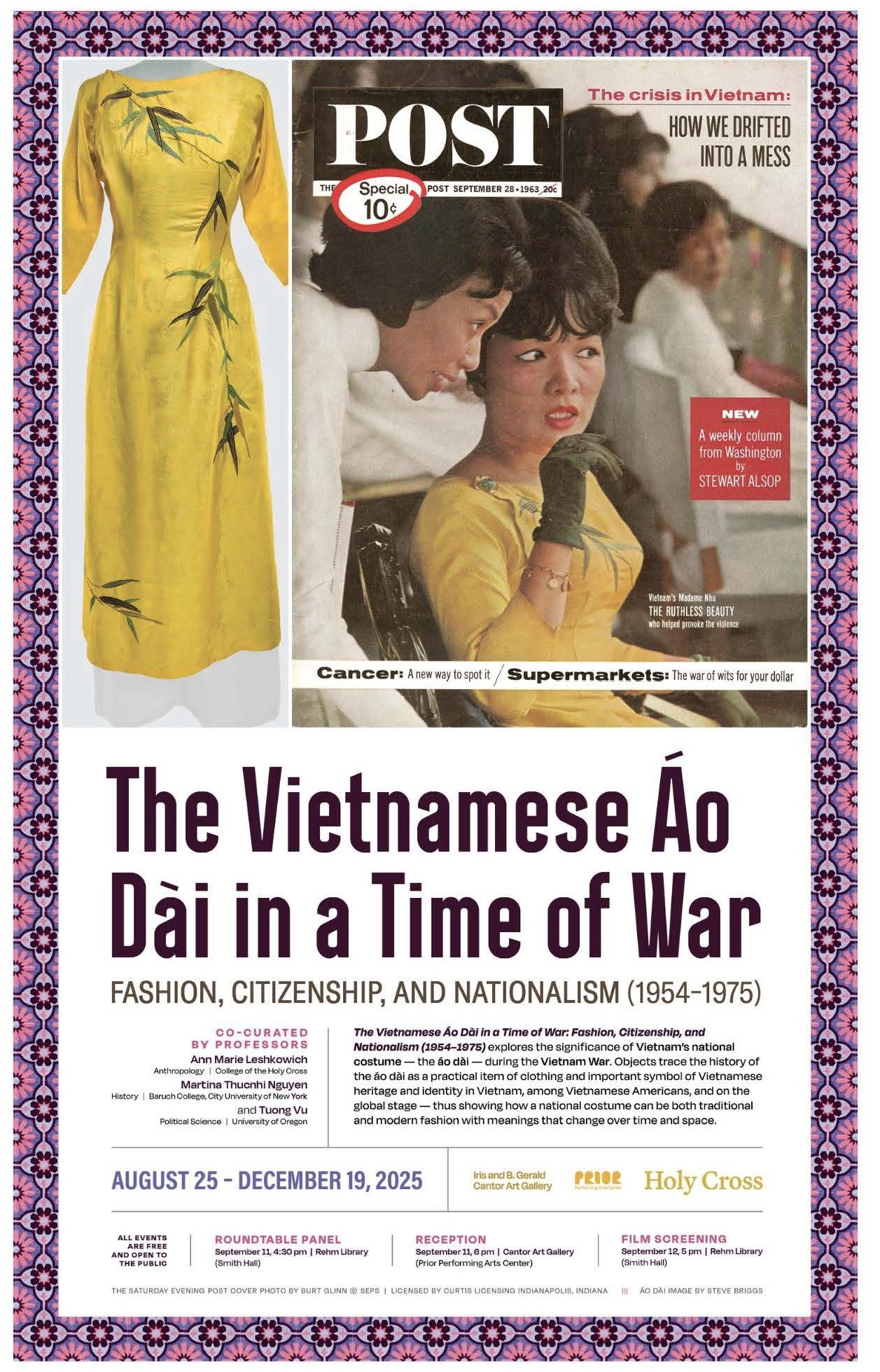
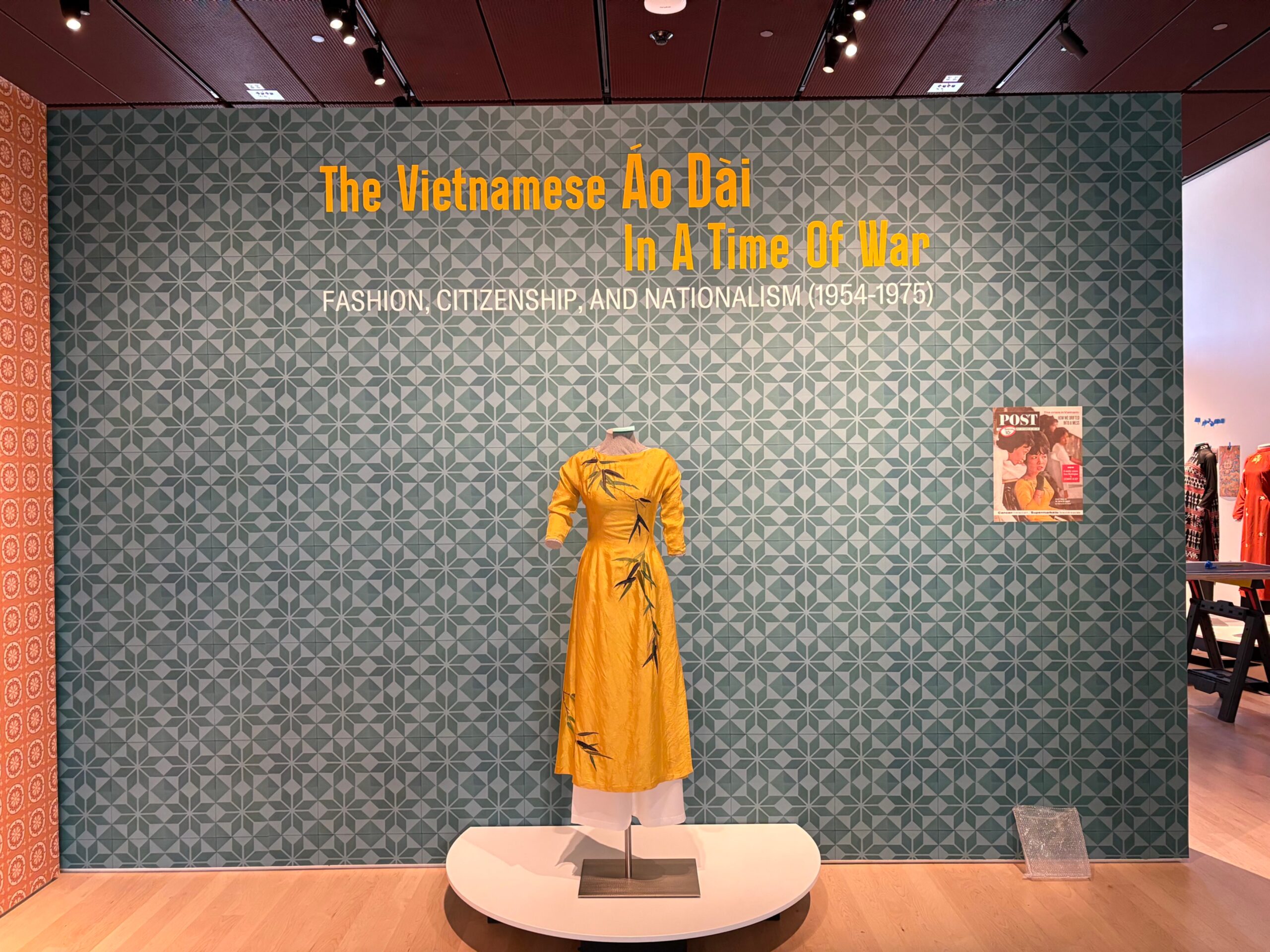
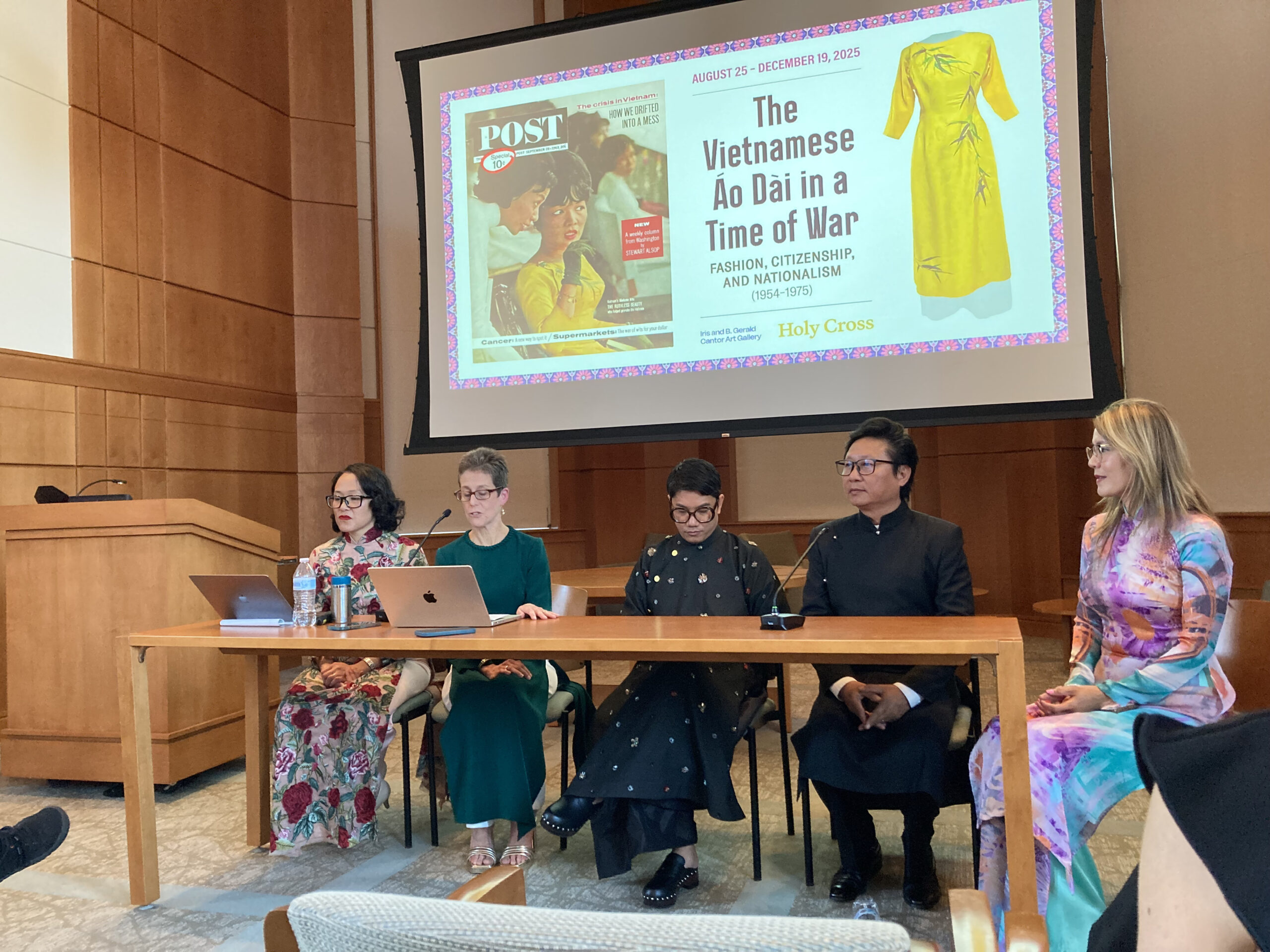
The Vietnamese Áo Dài in a Time of War:
Fashion, Citizenship, and Nationalism (1954–1975)
Organized by: Ann Marie Leshkowich (College of the Holy Cross), Martina Thucnhi Nguyen (Baruch College, CUNY), and Tuong Vu (University of Oregon)
Exhibition Date: Fall 2025
Location: Iris and B. Gerald Cantor Art Gallery, College of the Holy Cross, Worcester, MA
***
Exhibition Introduction
by Ann Marie Leshkowich and Martina Thucnhi Nguyen
In a time of war, fashion can be a political weapon.
When you think of the Vietnam War, what comes to mind? Most likely horrific violence, tragic loss of life, political protest, and refugees. A complex civil and global war that divided citizens and families, in both Vietnam and the US. Legacies that haunt us to this day.
Chances are, your mental images of the Vietnam War do not include fashion. But, fifty years after the official end of the war, we invite you to discover the crucial role that the áo dài—Vietnam’s national costume—played within Vietnam and on the global stage during the tumultuous decades from 1954 to 1975.
During this period, Vietnam was divided into two countries: the anticommunist Republic of Vietnam (South Vietnam) and the communist Democratic Republic of Vietnam (North Vietnam). The áo dài was a powerful political symbol that first ladies and other prominent figures deliberately used to assert Vietnamese identity, domestically and globally, amidst years of violent civil and international war.
To understand why the áo dài mattered during the Vietnam War, The Vietnamese Áo Dài in a Time of War: Fashion, Citizenship, and Nationalism (1954–1975) traces the garment’s emergence earlier in the 20th century under French colonialism. It also explores the áo dài’s enduring importance as a national costume in Vietnam today and to the Vietnamese American diaspora. Past struggles shape present identities.
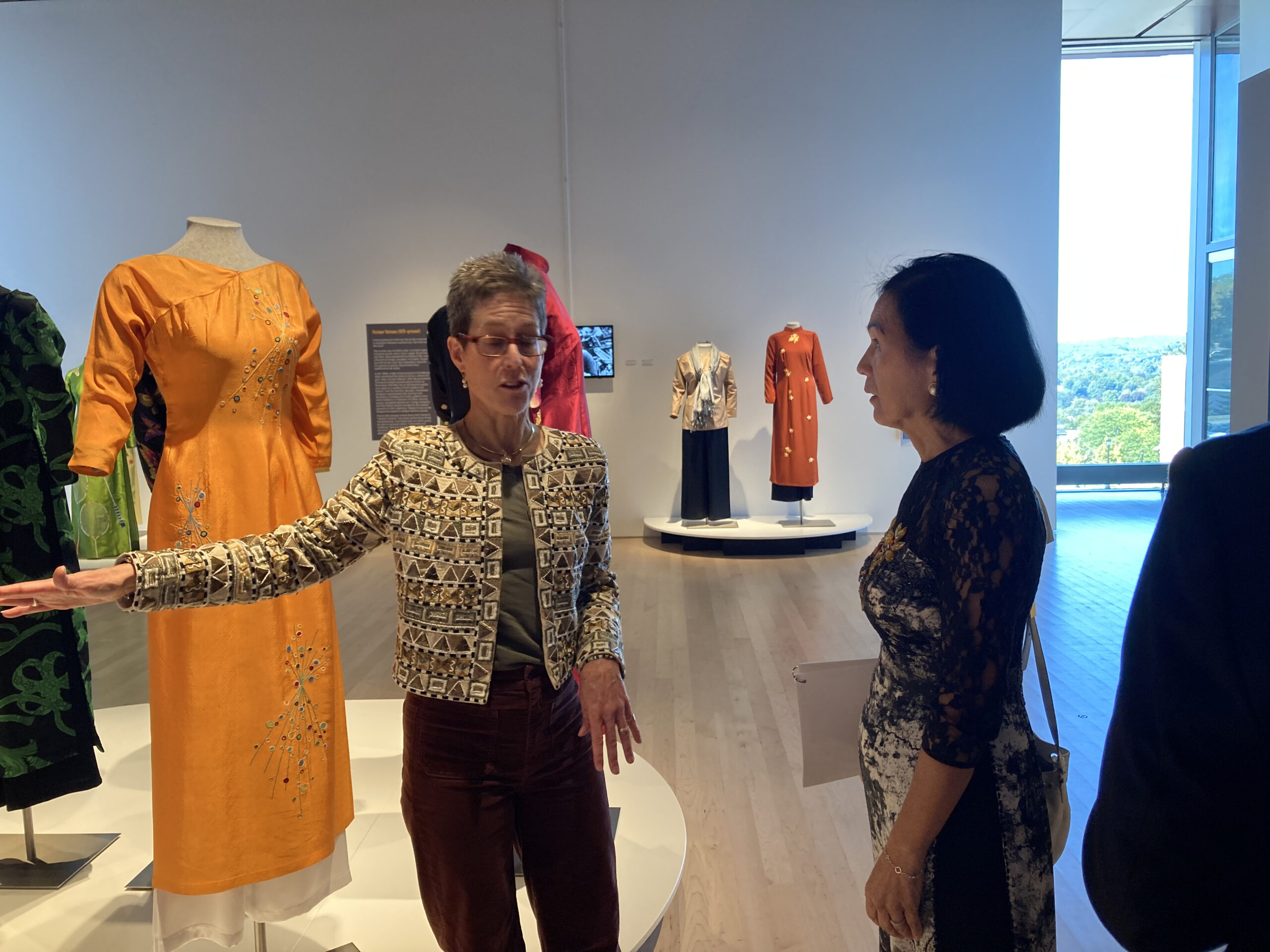
For too long, narratives of the Vietnam War in the US have focused on military history, male experiences, and American perspectives. This exhibition makes Vietnamese women, national costumes, and everyday life central to the story of the war. Displayed for the very first time, these original áo dài from the Vietnam War era, alongside reproductions of historical pieces and more recent designer creations, prove that fashion is not just a personal choice. It is profoundly political.
Section 1: From Imperial Dress to National Costume (Premodern era to 1945)
“Traditional” national costumes are very much modern inventions. Their meanings change over time and space.
The áo dài is a modern creation that draws from a blend of past clothing that reflected Vietnam’s complex culture and colonial history. Despite being universally accepted today as the enduring symbol of Vietnamese heritage and traditions, the garment was actually “invented” in 1934 by a Hanoi designer named “Lemur” Nguyễn Cát Tường. Lemur took elements of existing clothing and combined them with modern influences into an outfit that he believed captured Vietnam’s heterogenous identity after a thousand years of Chinese domination, centuries of internal division and civil war, and decades of French colonial rule. The resulting áo Lemur, or Lemur tunic, reveled in its hybrid nature. But critics argued that the garment was too French and not “Vietnamese” enough. This began a series of debates about “national costume,” to define what exactly Vietnamese national identity is and how it should be represented in clothing.
Section 2: Republic of Vietnam (1955–1975)
How can clothing represent a new nation? In 1955, the newly formed Republic of Vietnam (RVN)—commonly referred to as “South Vietnam” and allied with the United States—sought to assert its independent, anti-communist identity and claimed to represent the entire postcolonial nation.
The áo dài became a powerful instrument of RVN nationalism and soft diplomacy. At the forefront of this visual branding were two women who served as “First Ladies” of the Republic. Their different styles reflected their distinct approaches to nation building and diplomacy.
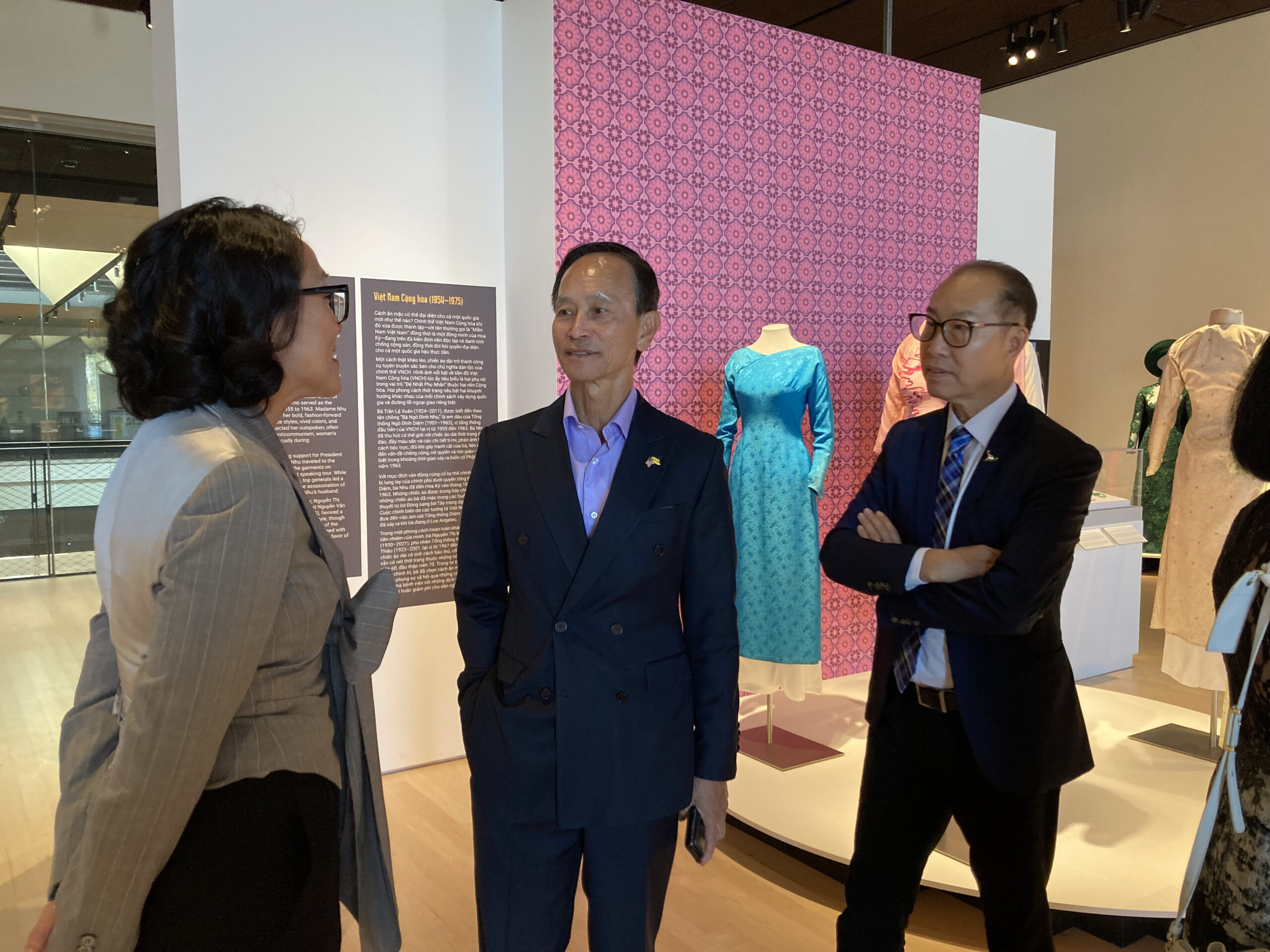
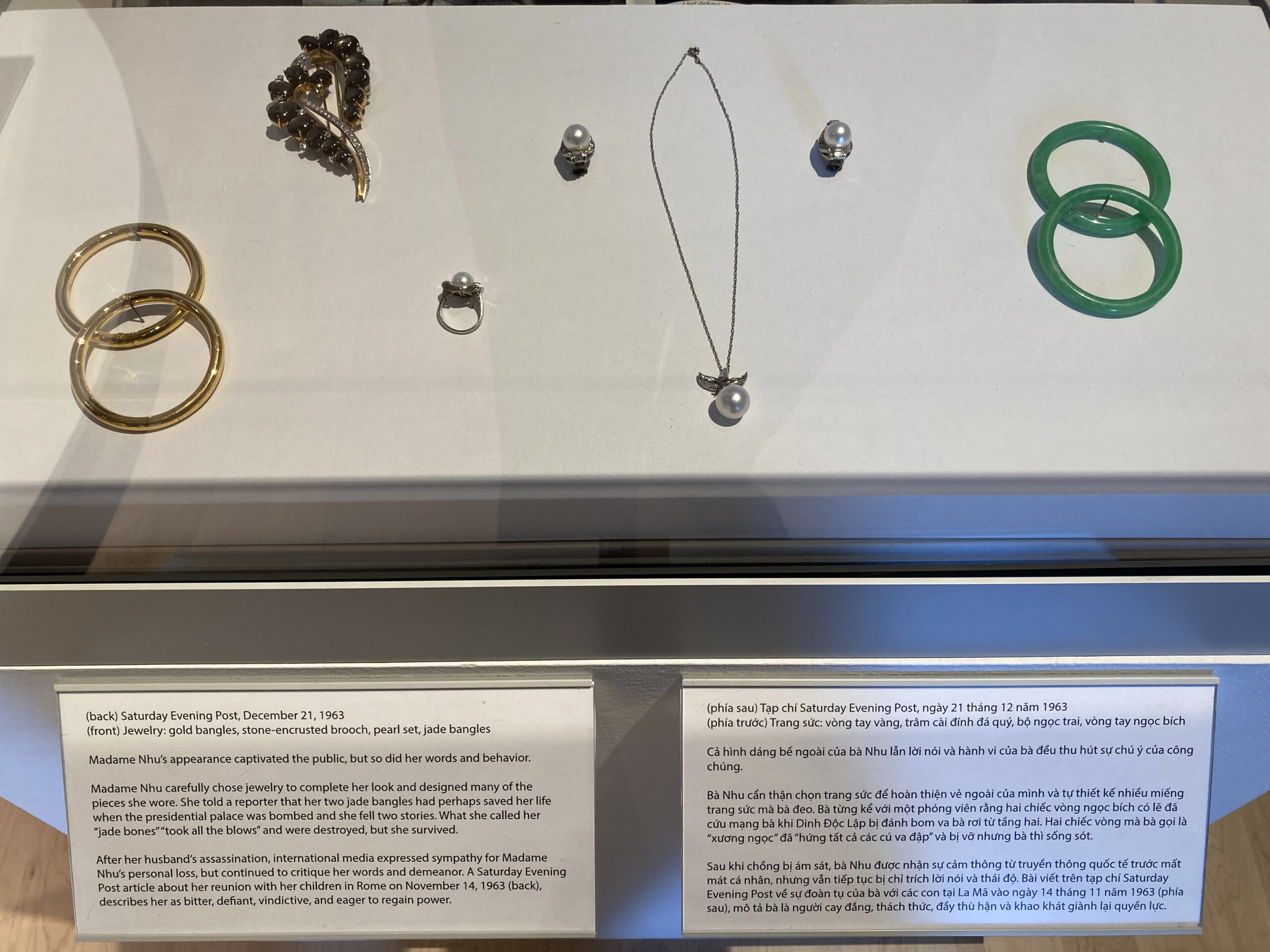
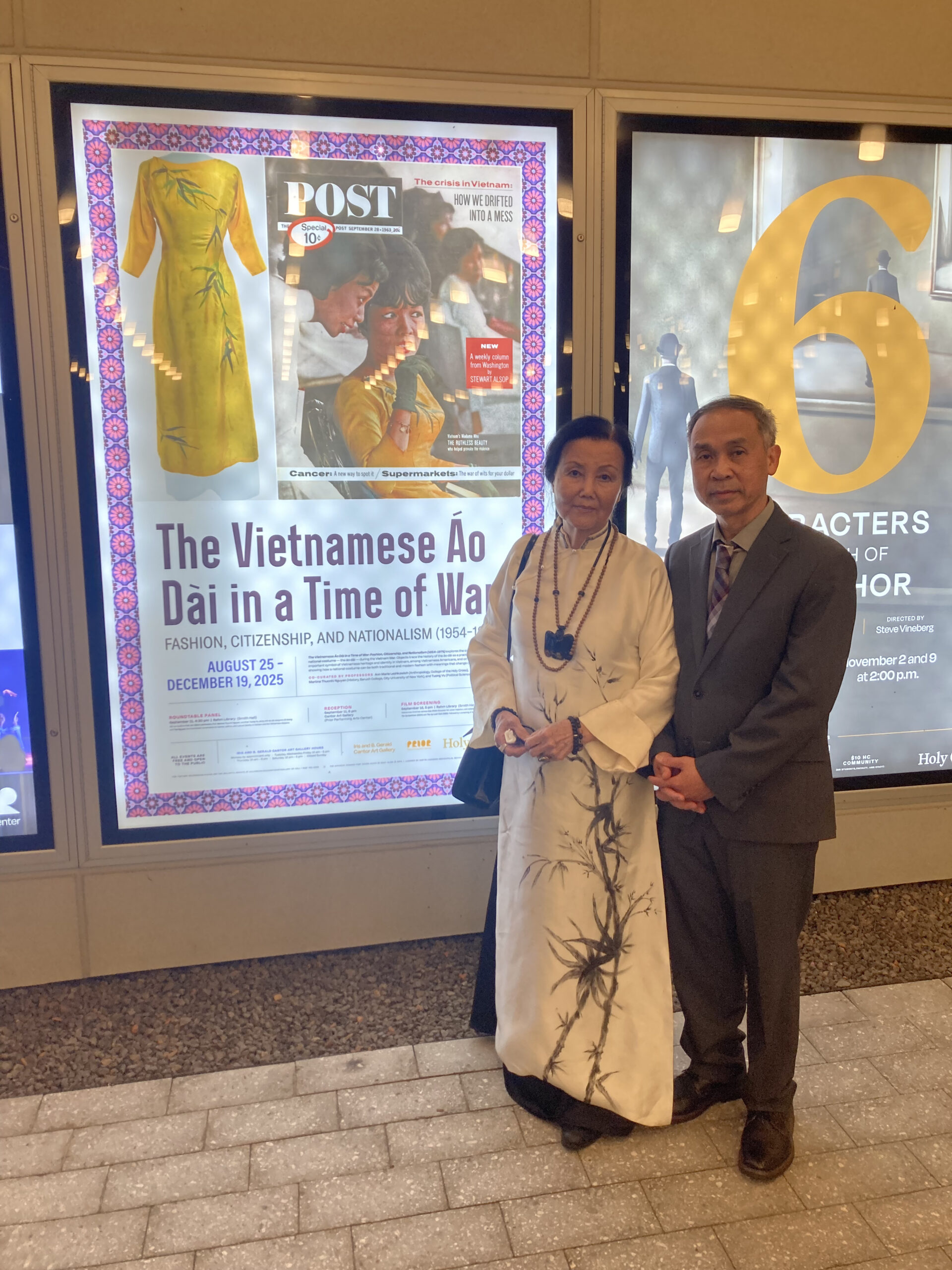
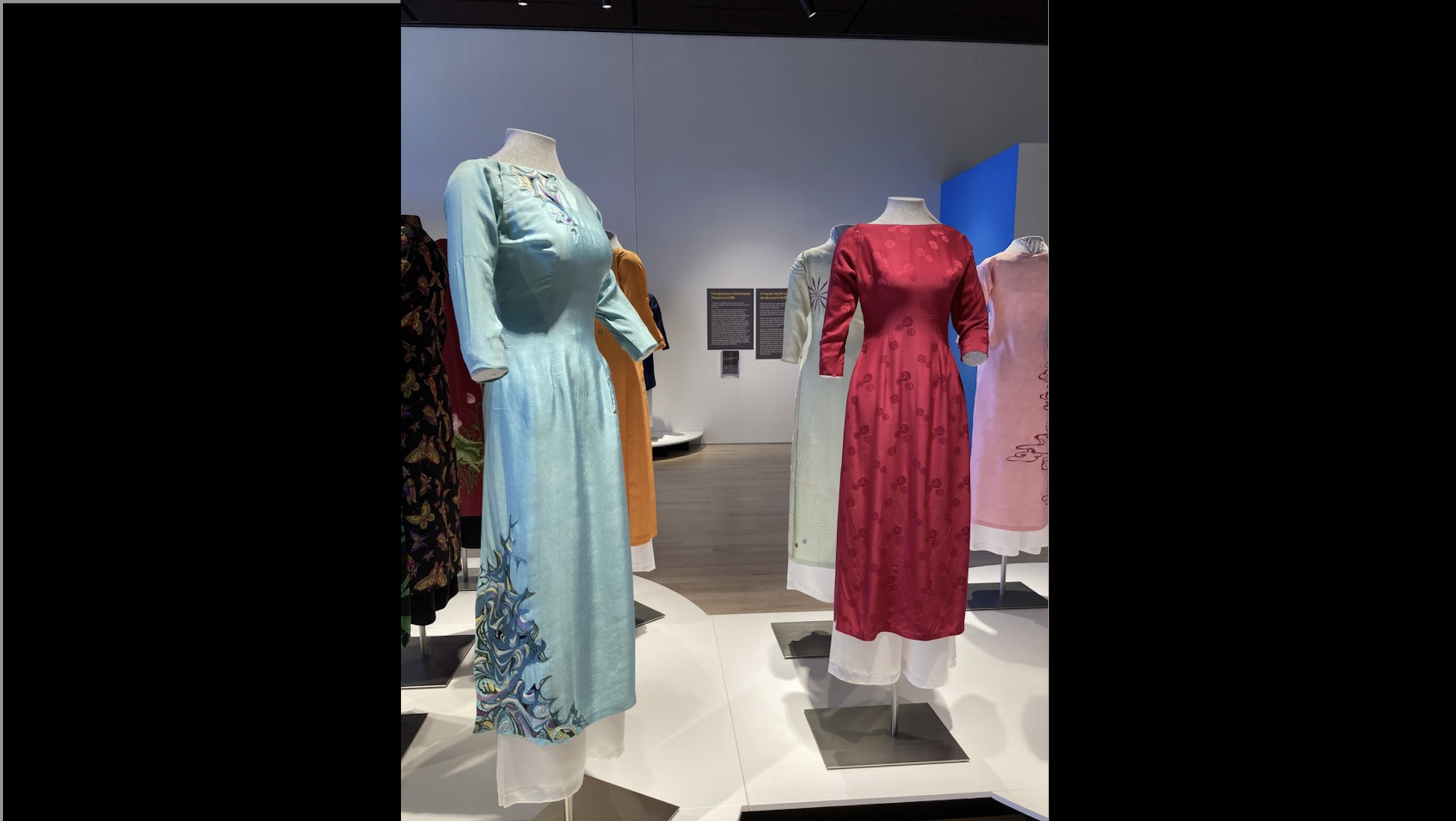
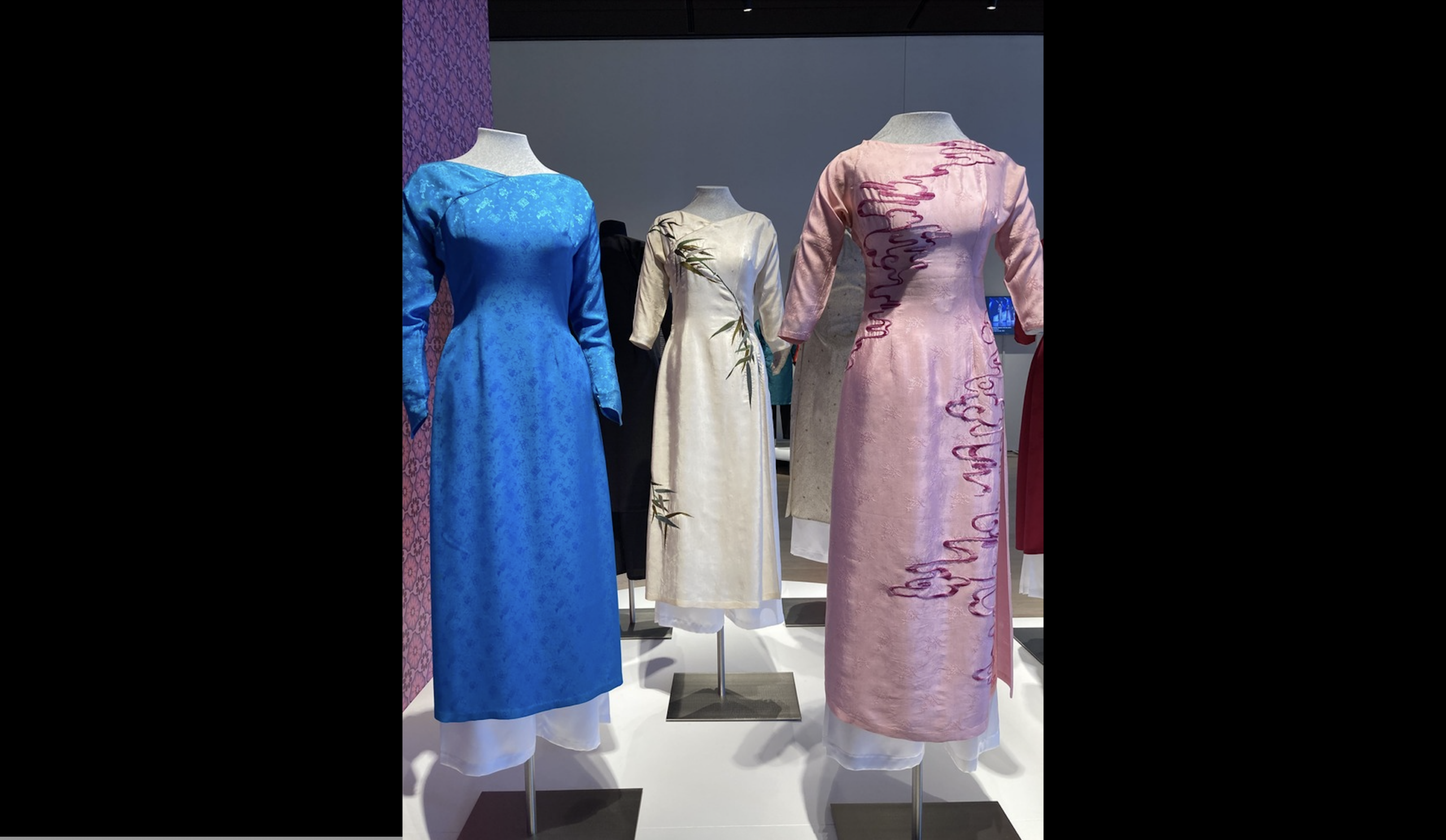
Trần Lệ Xuân (1924–2011), more commonly known as Madame Ngô Đình Nhu, was the sister-in-law of Ngô Đình Diệm (1901–1963), who served as the RVN’s first president from 1955 to 1963. Madame Nhu gained global attention for her bold, fashion-forward áo dài, showcasing unique styles, vivid colors, and intricate details that reflected her outspoken, often controversial, views on anti-communism, women’s rights, and religion—most especially during the 1963 “Buddhist Crisis.”
In an attempt to boost waning support for President Diệm’s government, Madame Nhu traveled to the US in October 1963. She wore the garments on display during her coast-to-coast speaking tour. While Madame Nhu was in Los Angeles, top generals led a successful coup that resulted in the assassination of both President Diệm and Madame Nhu’s husband.
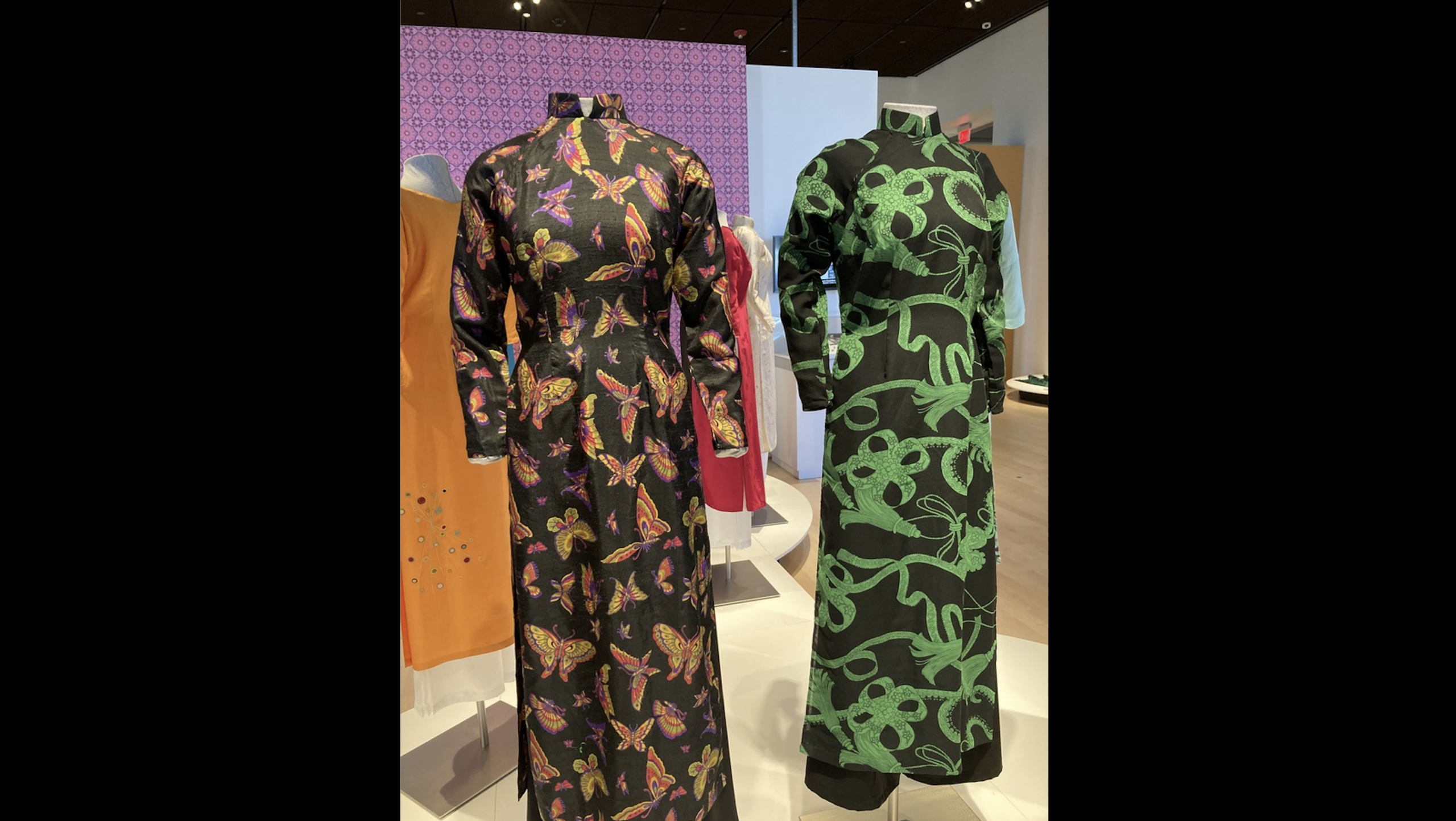
In striking contrast to her predecessor, Nguyễn Thị Mai Anh (1930–2021), wife of President Nguyễn Văn Thiệu (1923–2001; in office, 1967–1975), favored a more conventional, conservative áo dài style, though often featuring bold patterns characteristic of the late ‘60s and early ‘70s. Her appearance aligned with her avoidance of direct political statements in favor of focusing on social service activities, such as the construction of a hospital to provide free or reduced cost medical examinations and treatment to those in need.
Section 3: Democratic Republic of Vietnam and National Liberation Front (1954–1975)
Despite denouncing fashion as decadent and capitalist, communist North Vietnam also used clothing and the áo dài as political weapons.
The Democratic Republic of Vietnam (DRV) sought to revolutionize Vietnamese national identity and women’s roles. Women fought to defend villages and move supplies along the Hồ Chí Minh Trail as it wound from the north, through Laos and Cambodia, and into southern Vietnam. National Liberation Front (NLF) Deputy Commander Madame Nguyễn Thị Định and the members of her “long-haired army” wore a more utilitarian outfit characteristic of the Mekong Delta: a tunic known as the áo bà ba, straight or wide-legged pants, and checkered scarf.
Women in the north and the NLF tended not to wear the áo dài as much in daily life. Even so, the DRV used the áo dài to claim that the northern regime represented authentic Vietnamese cultural heritage. Throughout four years of peace negotiations in Paris, Madame Nguyễn Thị Bình, Foreign Minister of the Provisional Revolutionary Government (PRG) of the Republic of South Vietnam, deliberately wore áo dài to show the world that communism had a gentler side.
Section 4: Postwar Vietnam (1975–present)
Following the end of the war, the áo dài continued to represent Vietnam’s national soul. But what was this soul?
The country was reunified under a socialist regime. Consumer goods were in short supply. Boatnecks and other styles popularized by Madame Nhu were criticized as foreign, decadent, immodest. People wore the áo dài much less frequently in daily life. For special occasions, they donned more traditional áo dài styles.
In the 1980s, a high school principal in the Mekong Delta reinstituted the white áo dài as a uniform for girls. Other schools followed. After the government introduced market-oriented policies known as Renovation (Đổi mới), the áo dài became popular once again as a symbol of both tradition and fashion. Over the next four decades, Vietnamese designers experimented with structure and decoration, including retro motifs, patterns from textile traditions of Vietnam’s 53 ethnic minority groups, and global abstract art. Foreign designers and fast fashion brands included áo dài-inspired garments in their collections. Ready-to-wear áo dài ranging from playful to elegant became popular.
The áo dài’s postwar revival proves that Vietnam’s “national costume” can evolve and be many things simultaneously. Associated with one ethnic group, yet able to represent others. Fashionable and traditional. National and global. But it also raises questions about the power of fashion to distort or appropriate cultural heritage.
Section 5: The Vietnamese American Diaspora (1975–present)
For exiled Vietnamese living in the US, the áo dài has become a powerful symbol bridging the homeland they lost and the new identity forged in their adopted country. Áo dài pageants and fashion shows attempt to socialize young Vietnamese American women to embody a cultural heritage that communism was said to have destroyed. Straight-to-video musical variety shows such as Asia and Paris by Night showcase exiled Vietnamese singers performing melodramatic ballads in áo dài, invoking nostalgia for a bygone Vietnam. Over the years, these videos were covertly viewed in communist Vietnam, creating a cross-cultural pollination that arguably reignited the popularity of the áo dài in its homeland.
While Vietnamese have lived abroad as early as the 18th century, the end of the war marked the most important moment in the history of the Vietnamese diaspora. From 1975 to the mid 1990s, about two million Vietnamese left their homeland and settled around the world, as refugees, students, workers, and family migrants. Significant overseas Vietnamese communities can be found in France, Australia, Germany, and Canada, but the largest by far is in the United States with 2.3 million.
The garments and objects in this section reflect the various ways in which members of the Vietnamese American diaspora constructed their new identities in the US with reference to the homeland they left behind.
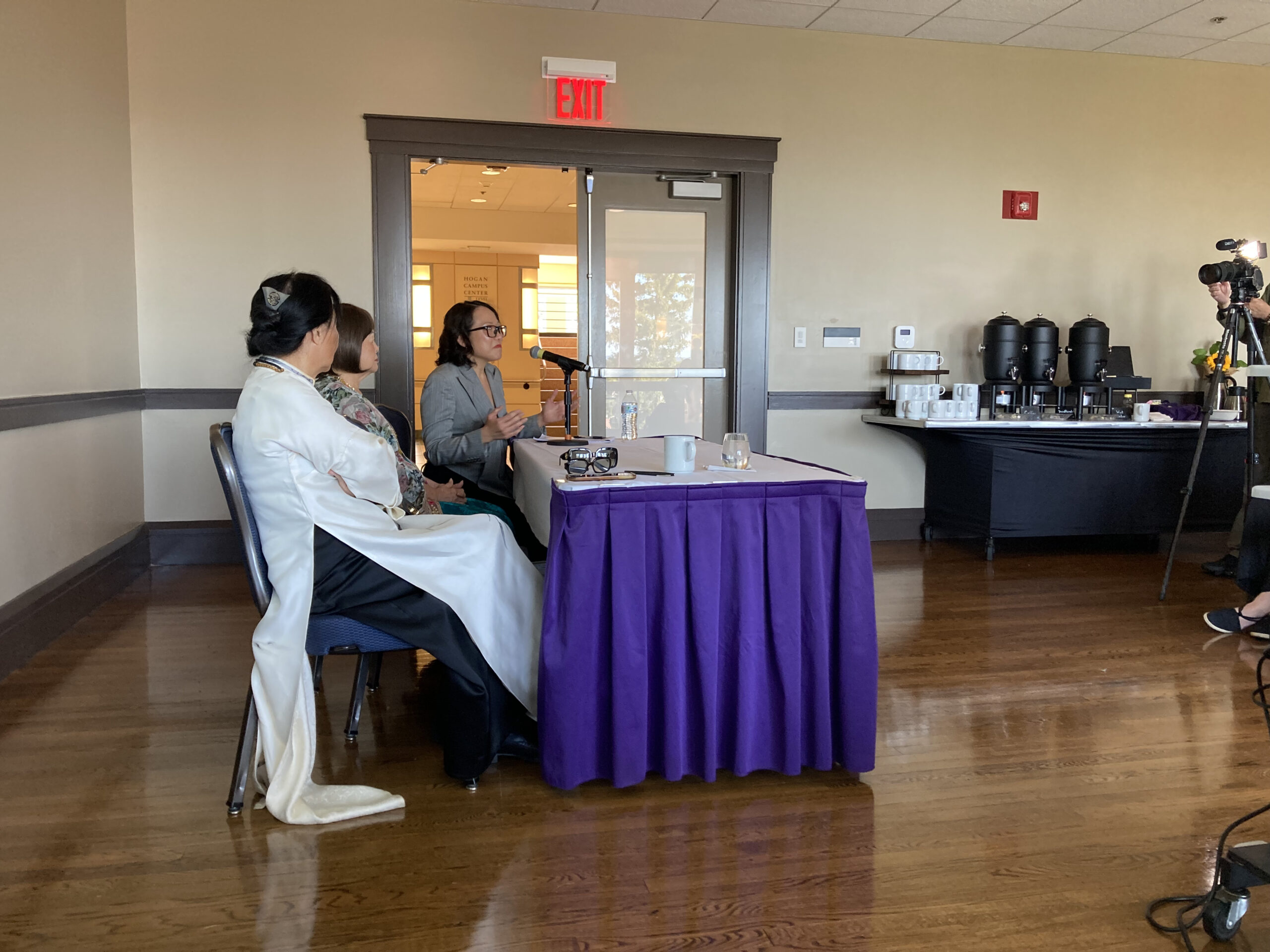
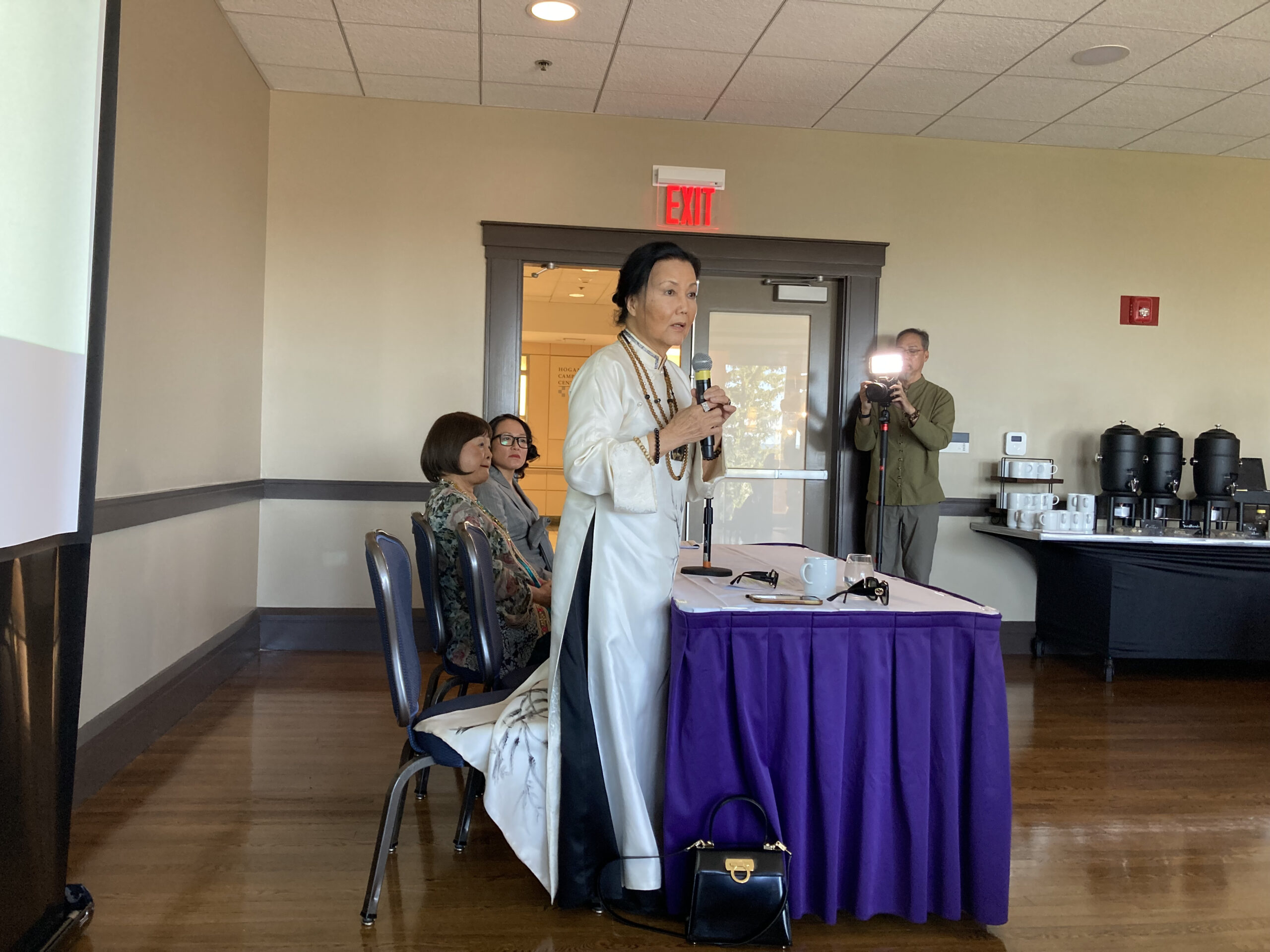
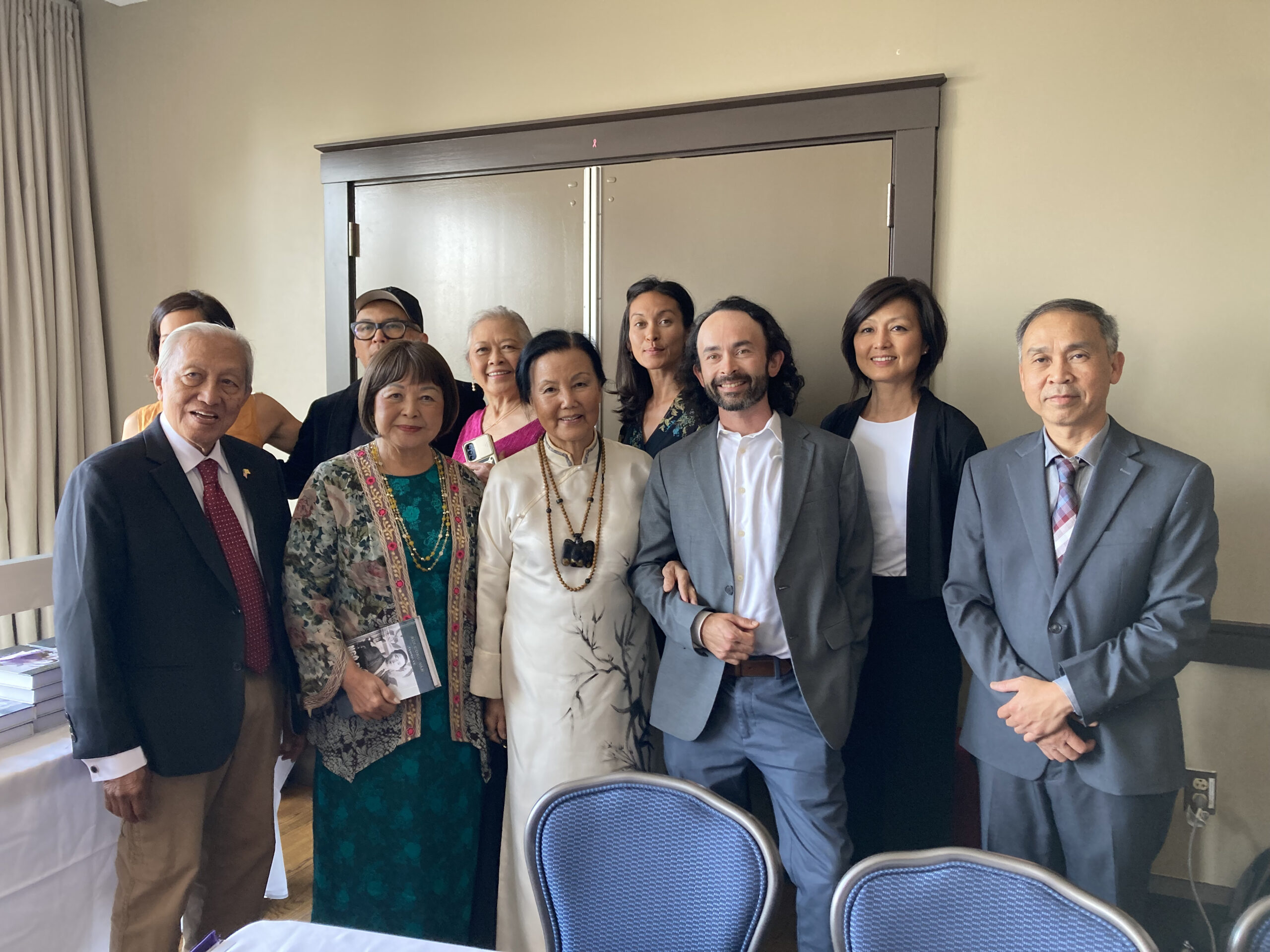
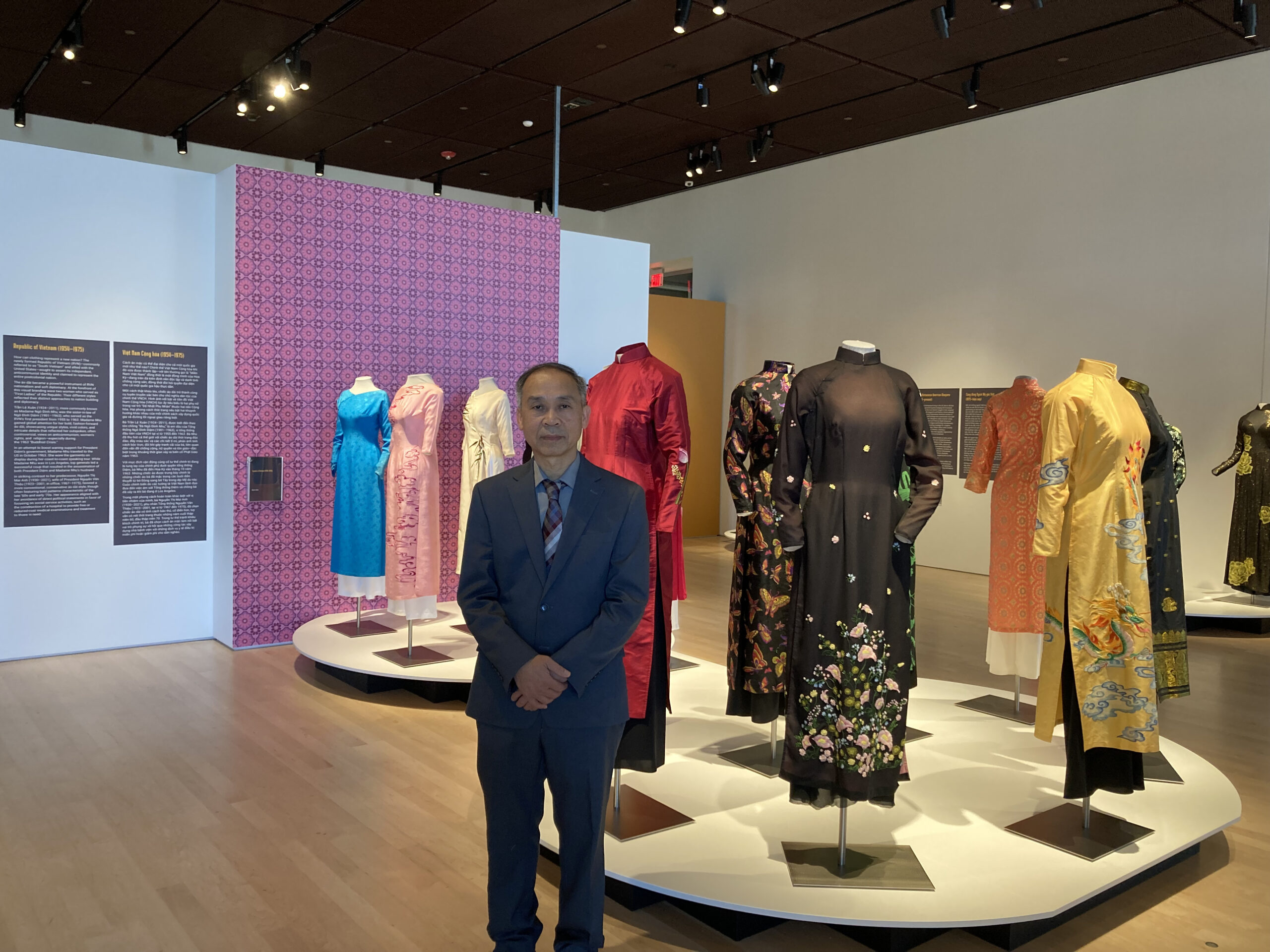
PREFACE to the Exhibit Catalogue
Madame Ngô Đình Nhu’s Áo Dài and the Republic of Vietnam in Vietnamese History
by Tuong Vu, University of Oregon
Trần Lệ Xuân, commonly known by her husband’s name as Madame Ngô Đình Nhu, was among the most prominent political figures in the former Republic of Vietnam (RVN) that existed in southern Vietnam as an independent state from 1954 to 1975. Ngô Đình Nhu was the brother and advisor of President Ngô Đình Diệm, who was unmarried. Madame Nhu often took on the role of a first lady in public affairs during 1955–1963 when President Diệm led the Republic. Madame Nhu left the country in September 1963 for a diplomatic trip amid an intense political conflict in South Vietnam that caused the downfall and deaths of President Diệm and her husband less than two months later. She never returned to her homeland and lived out the rest of her life in exile in Rome and Paris.
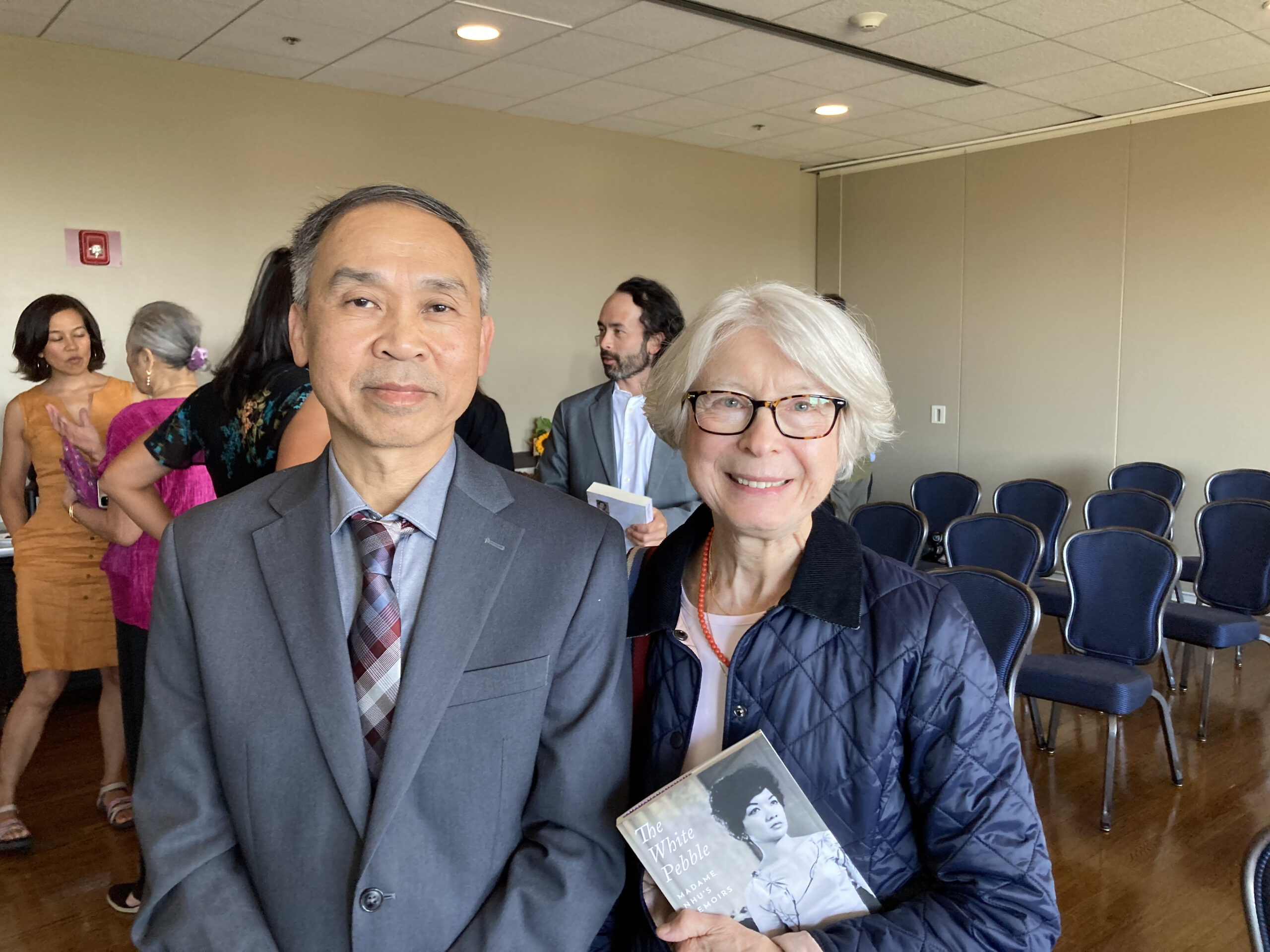
These events happened before I was born, and I could never have expected to have anything to do with the Ngô family. In late November 2019, Vũ Hồng Trang, a graduate student from Vietnam who was studying in Beijing, contacted me out of the blue. Earlier she had studied in Europe and wrote her MA thesis comparing Madame Ngô Đình Nhu and Madame Chiang Kai-shek. Through her research she developed a friendship with Mr. Olindo Borsoi, the widower of Madame Ngô Đình Nhu’s daughter Ngô Đình Lệ Quyên. Vũ Hồng Trang visited their house in Rome, where she was shown what Madame Nhu left behind after her death in 2011, including her memoir. She also volunteered to translate Ngô Đình Lệ Quyên’s memoir from Italian into Vietnamese. Ms. Lệ Quyên herself had died in a traffic accident in 2012.
By 2019, Mr. Borsoi had a new partner and was preparing to move to a new residence. When Vũ Hồng Trang learned that he was looking for a trusted institution to which to donate Madame Ngô Đình Nhu’s documents and other personal effects, she introduced Mr. Borsoi to me. From my interviews in the media, Vũ Hồng Trang had found out about our US-Vietnam Research Center at the University of Oregon and our program to promote research and education about the Republic of Vietnam. Following email exchanges, Mr. Borsoi agreed to donate Madame Nhu’s documents and loan many of her áo dài to our center for our use as appropriate. Mr. Nguyễn Đức Cường, a former RVN minister who had supported our Center in various activities, offered me useful advice, financial support, and kind encouragement in the matter.
When the boxes with those items arrived in Eugene from Rome in August 2020, the pandemic was raging around the globe. I was fascinated by what I saw, which took me to a completely different, distant world that no longer existed. The documents were mostly Madame Nhu’s personal correspondence after she had left Saigon in 1963. There were handwritten drafts and copies of her speeches or statements, either delivered during event appearances or issued to the press in her name. She was able to bring with her very few government documents, but the collection of her writings reveals her personal thoughts and efforts to cope with the tragedy that befell her family (and in her mind also her nation). These valuable writings give me an idea for a book manuscript that explores the politics of her trip and the complexities in her thoughts.
Her áo dài were stunning, even though some pieces were clearly well used. Their styles, their colors, and the fabric used to make them stood out. The garments had a striking visceral effect on me, even though I have little knowledge about the áo dài or fashion. Mr. Borsoi kindly sent in advance some images of Madame Nhu in those outfits that had appeared on the covers of various American magazines. As I held up the garments and reviewed the images, I could only imagine how they had once radiated grace and communicated a distinct sense of beauty and style that must have captivated the attention of many people, Vietnamese and foreigners, at the time.
I was trained as a political scientist. States and revolutions have been the main themes of my scholarship. I actually began studying the Republic of Vietnam only about a decade ago, and my journey to discover the Republic of Vietnam was a long one. I was born a citizen of that Republic, but it was defeated and annexed by its communist enemy when I was barely nine years old. Subsequently throughout my life and scholarly career up to the early 2010s, both in Vietnam and in the US, I had vague doubts but could only accept the conventional wisdom that the RVN was a mere adjunct to the American empire and was doomed to fail from the start.
In the popular image, the Republic was a castle on sand built by US money and blood. It did not carry any authentic Vietnamese identity nor have any legitimacy among the Vietnamese public. This conventional wisdom emerged in the late 1960s, then influenced by antiwar sentiments in the US and now preserved by many members of the American political elites who had come of age in that era. The Republic’s death in 1975 has made it easier for this narrative to be believed by members of younger generations like me. If it had been worth anything, why did it end up a failure?
Time has changed, however. In the last 15 years, a new generation of scholars has shared revelations with fresh sources that began to shift scholarly, if not popular, perceptions of the RVN. The Republic has become a legitimate topic of study and analysis, not one to be ridiculed and offhandedly dismissed. Its destruction may or may not have had anything to do with its complex and frequently chaotic politics, its diverse and vibrant society and economy despite the war, its rich and globalized culture, and the democratic aspirations of many members of its elite and ordinary people. The contrast between it and its alternative, the communist republic of North Vietnam, was so striking that it would not be an overstatement that they represented two different civilizations. As communist Vietnam today has embraced the market economy and reduced government control over society, it appears that the Republic not only represented a path not taken, but may also become a likely future destination.
Our US-Vietnam Research Center has been deeply involved in challenging the conventional wisdom about the RVN with new and more objective ways of thinking. We strive not to be misled by the intense sentiments people had during the extremely divisive Vietnam War, however valid they might have seemed. In October 2016, we organized a symposium at the University of California-Berkeley when 16 prominent figures of the RVN not only in government but also in society were invited to speak about their careers that contributed to building the Republic. An event of this scale and scope was the first since the end of war. The symposium was successful beyond our expectations. We followed up with an international workshop on Vietnamese republicanism in October 2019 that brought about 50 scholars from all over the world to Eugene, OR.
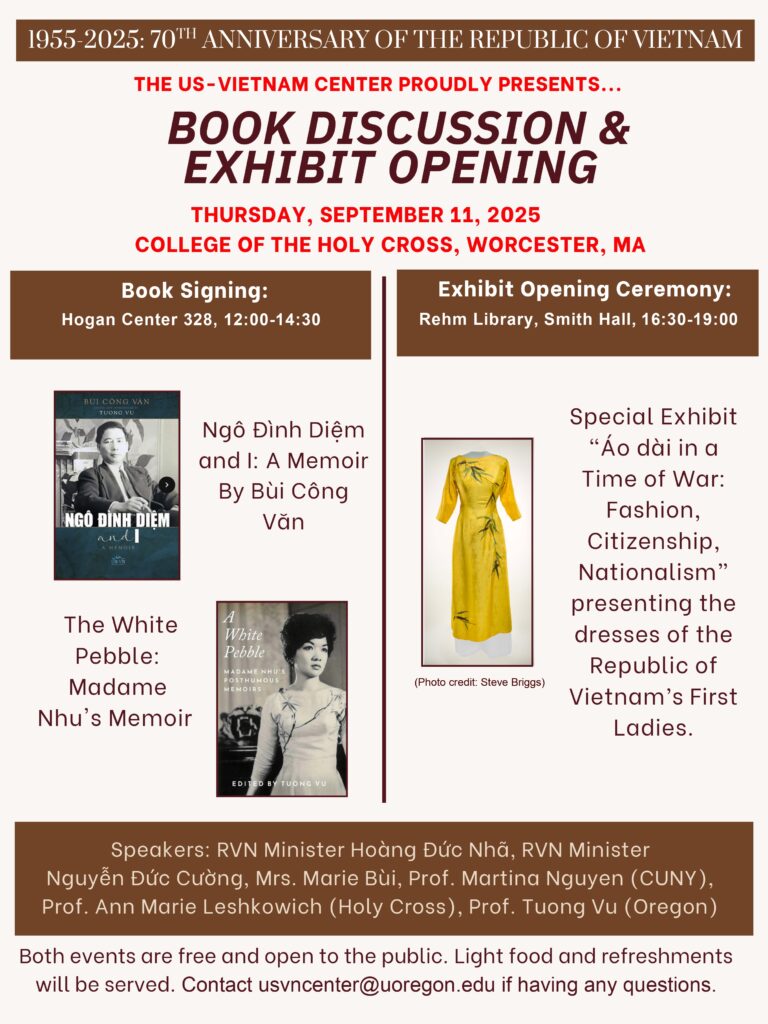
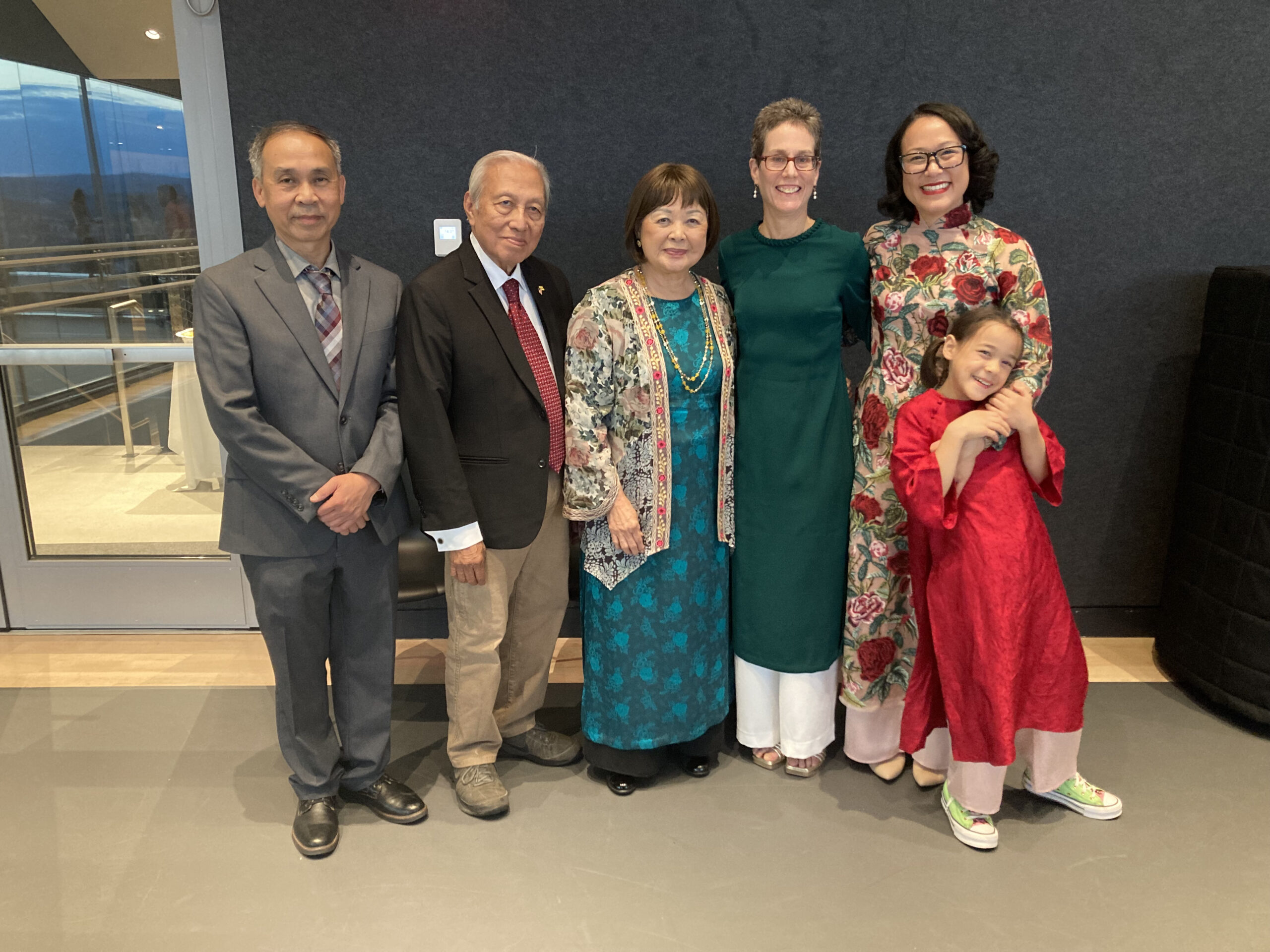
This workshop attracted the attention of the Vietnamese diaspora across the world and helped us establish trust with the Ngô family and, later, the family of former President Nguyễn Văn Thiệu, who headed the Republic during 1967–1975. We are grateful to their families for giving us a role in preserving the First Ladies’ áo dài and presenting them to the public. These áo dài are treasures of Vietnamese history since they not only expressed Vietnamese culture but also represented the proud Vietnamese national identity as this nation emerged from decades of colonial rule.
While the history of the áo dài remains to be written, the garment has seen its fortune change dramatically over time. It emerged as a fashionable dress among Vietnamese women in the 1930s, drawing in part on traditional costumes combined with modern sensibilities. When Vietnam was divided from 1954 to 1975, the áo dài was dismissed in North Vietnam for its association with past feudal and bourgeois cultures which the communist regime wanted to eliminate. It achieved its prominence only in South Vietnam under the RVN, and Madame Nhu is widely believed to have played an important role in consolidating its status as a national dress. The diaspora brought that tradition with them abroad, and one also witnesses a strong revival of interest in the outfit in Vietnam today after nearly four decades of reform.
We welcome and invite viewers of the exhibition to consider these questions: How did/does such a garment come to be seen and actually serve as a national symbol? What is contained within this outfit that has captured the pride of generations of Vietnamese, women and men? How has it represented Vietnamese culture to Vietnamese themselves and to foreigners? What roles did it play during the war as a symbol of national identity for the South Vietnamese government and, to a lesser extent, the North Vietnamese regime? How has it resisted or incorporated foreign, especially Western, elements to adapt to changing times? Who contributed the most to its development: designers, tailors, or consumers? Which factors—ideas, technologies, or social changes—have been most significant in shaping its design and use?