Center for Asian-Pacific Studies and Asian Studies Program
University of Oregon, Eugene, OR
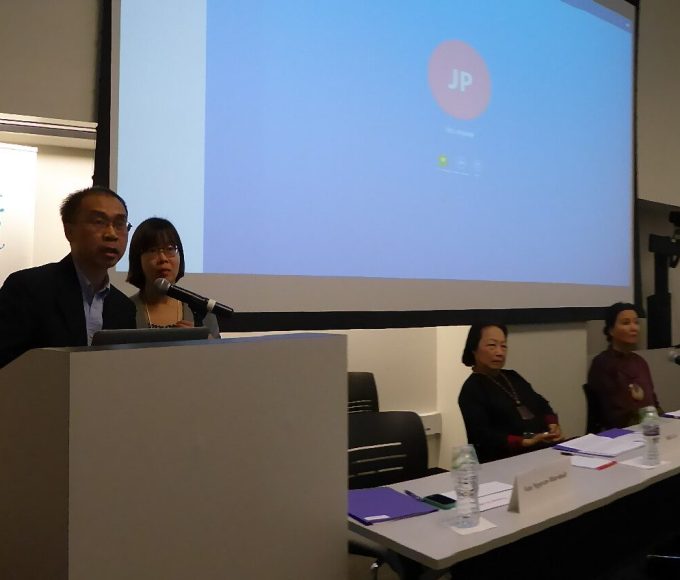
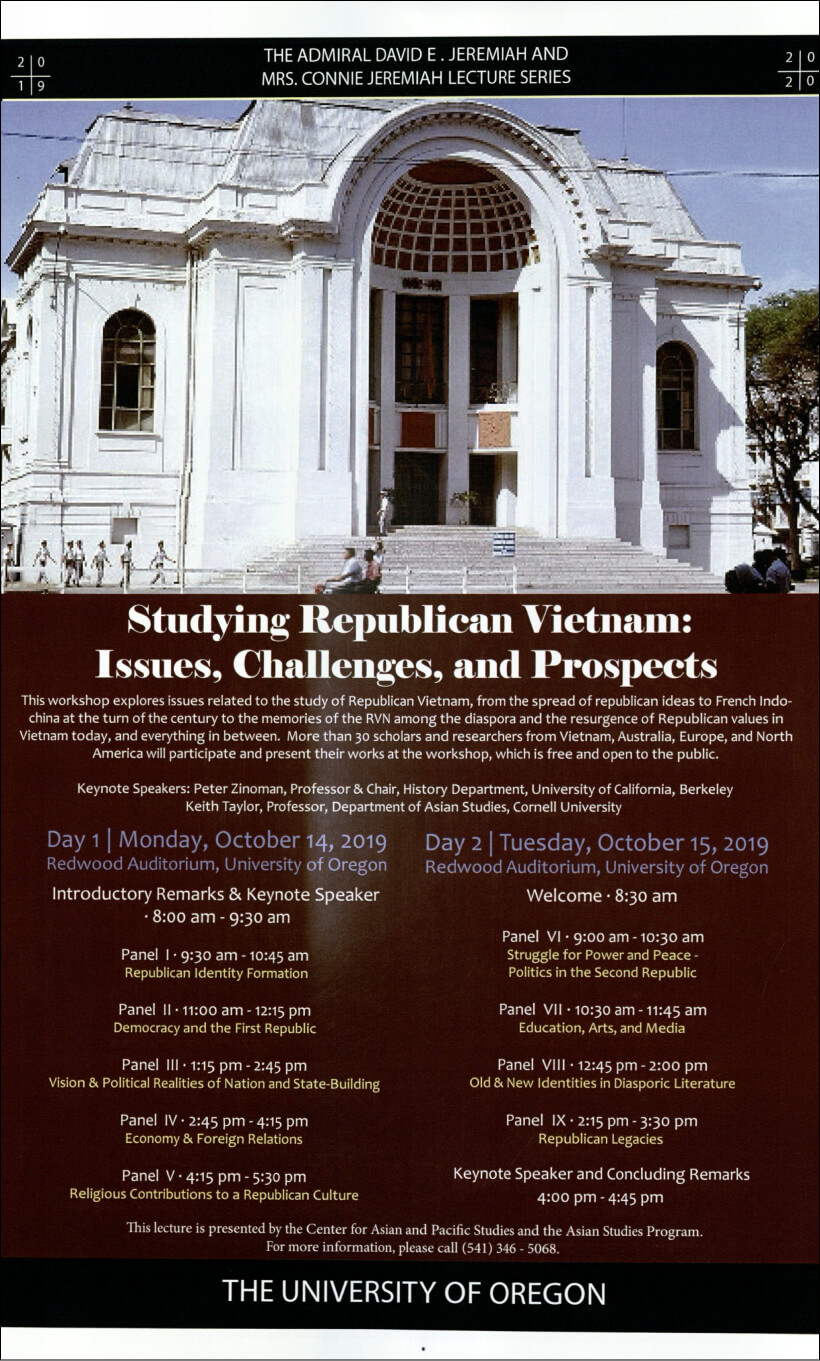
Workshop on Studying Republican Vietnam: Issues, Challenges, and Prospects
Workshop Date: October 14-15, 2019
This international workshop explores the issues, challenges and prospects in studying republicanism in Vietnam. Republican Vietnam is a broad subject, extending through the 20th century and beyond. The issues range from the spread of republican ideas to French Indochina at the turn of the century to the memories of the Republic of Vietnam among the diaspora and the resurgence of republican values in Vietnam today, and everything in between.
The workshop takes advantage of rising scholarly interests in the Republic of Vietnam (RVN) in the last decade, both in and outside of Vietnam. Western scholarship until recently was closely in line with communist propaganda, either ignoring the RVN or portraying it as an American creation in the US global scheme against communism. A combination of newly available sources and a younger generation of historians less shackled by the biases of the previous generation is producing new scholarship that shows the RVN in a new light, as the legitimate heir of the nationalist revolutionary movement that passionately aspired to republican values and ideals.
The workshop does not stop with the collapse of the RVN in 1975 but looks beyond it to identify its legacies both abroad and in Vietnam today. Among what the millions of Vietnamese refugees who fled communist rule carried with them to foreign shores were certain Republican values, memories of the RVN, and the trauma of life under communism. Among Vietnamese still in Vietnam, the republican legacies have persisted and republican ideas have begun to attract young Vietnamese since the communist regime was forced to accept market reform in the late 1980s.
BIOGRAPHIES OF SPEAKERS:
Alvin Khiêm BUI is a graduate student in the Department of History at University of Washington. He has spent the last four years in Vietnam: initially as a Fulbright Fellow, then as a venture capital investment associate with 500 Startups’ Vietnam-focused fund and finally as an educational consultant with Bedrock Vietnam.
Olga DROR, Professor of History at Texas A&M University, is a Henry Luce Fellow at the National Humanities Center for 2019-2020. Dror has authored, translated, and co-edited five books and numerous articles. Her most recent monograph Making Two Vietnams: War and Youth Identities, 1965-1975 was published in 2018 by Cambridge University Press. She is currently working on a monograph titled Ho Chi Minh’s Cult in Vietnamese Statehood.
Sean FEAR is a lecturer in international history at the University of Leeds. Fear’s work has been published in Diplomatic History and the Journal of Vietnamese Studies. He is currently working on a book manuscript, under contract with Harvard University Press, exploring South Vietnam’s domestic politics and foreign relations between 1967 and 1975.
Wynn GADKAR-WILCOX is Professor of History at Western Connecticut State University. He studies the intellectual history and historiography of modern Vietnam. He wrote Allegories of the Vietnamese Past (2010), East Asia and the West (with Xiaobing Li and Yi Sun) (2019), and Vietnam and the West (ed., 2010).
Jason GIBBS is the author of Rock Hà Nội & Rumba Cửu Long (2008). He wrote the entry for Vietnam in the Continuum Encyclopedia of Popular Music of the World and has published articles in Asian Music, Journal of Vietnamese Studies, Southeast Asian Research and BBC Tiếng Việt.
Christoph GIEBEL worked as a hospital ship medic in Indonesian waters in the Vietnamese refugee crisis around 1980 and was among the first Western students to study in post-war Việt Nam (1986-87). Holding a 1996 Cornell PhD, he has taught Southeast Asian history and Vietnamese Studies at the University of Washington since 1998.
HOANG Duc Nha served in the Government of the RVN soon after his return from his studies in the US in January 1965 with a BS in Electrical Engineering. He joined President Nguyễn Văn Thiệu’s staff in October 1967, later serving as Private Secretary (Chief of Staff) and concurrently Press Secretary to the President. In early 1973, Nhã joined the Cabinet as Minister of Mass Mobilization and Open Arms and Coordinating Minister for Nation Building. He resigned in November 1974 on policy differences with the Prime Minister.
HOANG Phong Tuan is a lecturer in the Faculty of Linguistics and Literary Studies, Ho Chi Minh City University of Education. He is interested in the relationship between social institutions and issues of literature creation, literary reception and mass culture. He has published on the history of conventions and institutions of literary reception in Vietnam, the mass readers of Chinese Romance Novels on the internet, mass media and rewriting war memories.
Tuan HOANG is assistant professor at Pepperdine University, teaching in the Great Books and History programs. Among his publications are “Ultramontanism, Nationalism, and the Fall of Saigon: Historicizing the Vietnamese American Catholic Experience,” American Catholic Studies 130:1 (Spring 2019); and “From Reeducation Camps to Little Saigons: Historicizing Vietnamese Diasporic Anticommunism,” Journal of Vietnamese Studies 11:2 (Summer 2016).
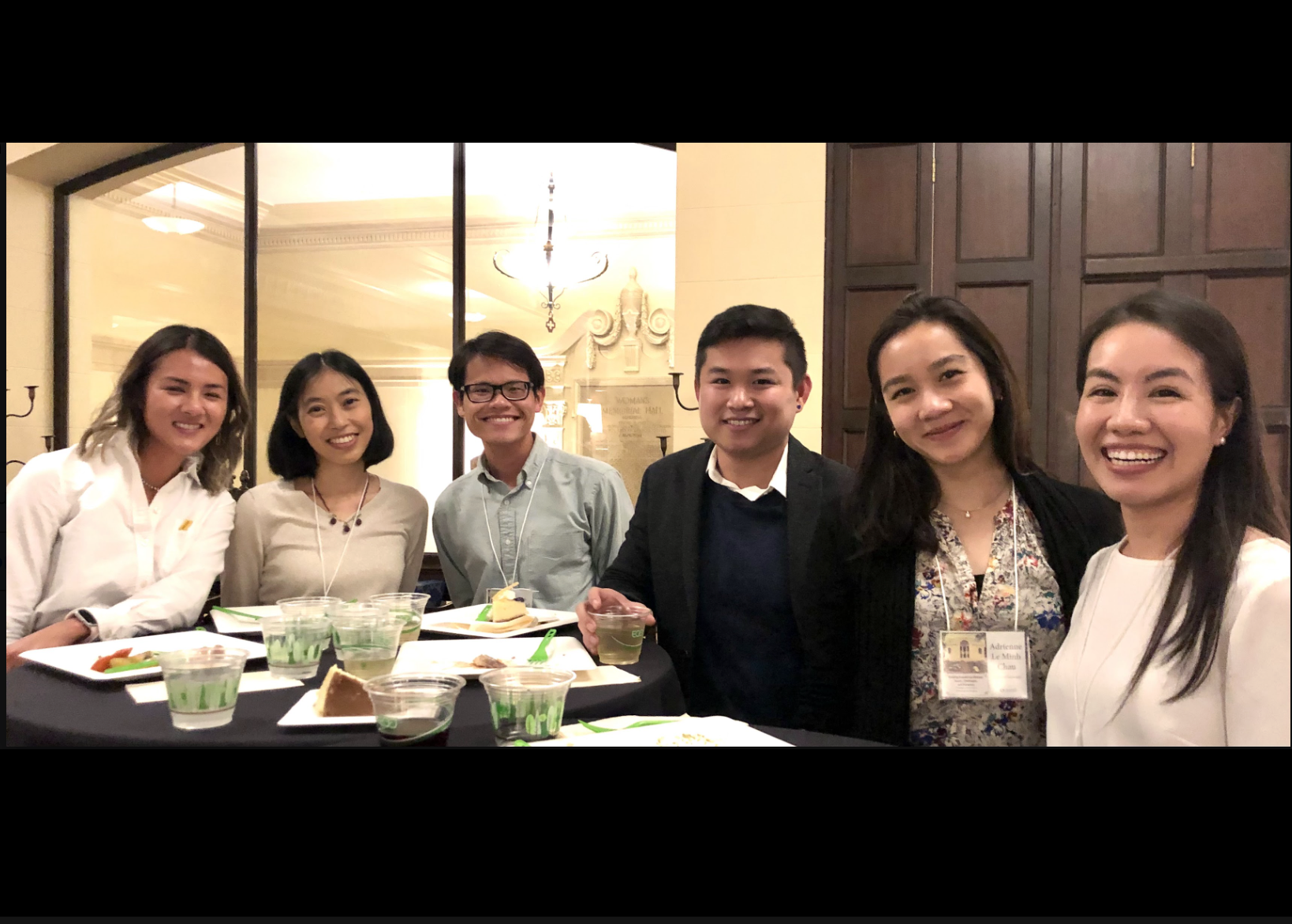
Adrienne Minh-Châu LE is a PhD student at Columbia University focusing on twentieth century Vietnamese and United States history. Her research interests include the South Vietnamese Buddhist anti-war movement, South Vietnamese civil society, postwar migration, and the Vietnamese diaspora.
Trinh My LUU earned her Ph.D. in Comparative Literature from the University of California, Berkeley. A former managing editor of the Journal of Vietnamese Studies, her dissertation studies Vietnamese law and literature under state socialism.
Edward MILLER is a historian of American Foreign Relations and modern Vietnam, with particular expertise in the Vietnam War. His scholarship explores the international and transnational dimensions of the war, and is based on research in archives in Vietnam, Europe, and the United States. He is the author of Misalliance: Ngo Dinh Diem, the United States, and the Fate of South Vietnam (Harvard University Press, 2013).
Cindy NGUYEN is a Postdoctoral Fellow at Brown University (History, University of California, Berkeley, 2019). Her book manuscript, “Reading and Misreading: The Social Life of Libraries and Colonial Control in Vietnam, 1865-1958” examines the cultural and political history of libraries in Hanoi and Saigon from the French colonial period through to the decolonization of libraries.
NGUYEN Duc Cuong graduated Summa Cum Laude from the University of New Hampshire with a Bachelor of Science in Electrical Engineering in 1963. He went on to graduate studies at the Massachusetts Institute of Technology where he earned a Master of Science in Electrical Engineering and completed the PhD course requirements. His ten-year career with the RVN government began in June 1965 upon his return to Saigon. He served as Vice Minister for Trade in 1970-73 and Minister of Trade and Industry in 1973-74.
Duy Lap NGUYEN is assistant professor in the Department of Modern and Classical Languages at the University of Houston. His research interests include critical theory and popular culture. His book The Unimagined Community: Imperialism and Culture in South Vietnam is forthcoming in December 2019 with Manchester University Press.
NGUYEN Luong Hai Khoi received his doctorate from Nihon University, Japan and is a research fellow at the Global Studies Institute at the University of Oregon. He is the former head of the literary theory division at University of Education, Ho Chi Minh City, Vietnam. His research focuses on Asian comparative thought, modernization thought in Asia, and the history of the Vietnamese republicanism.
NGUYEN Manh Hung is Professor Emeritus of Government and International Relations at George Mason University. Prior to 1975, he was Deputy Minister of the Republic of Vietnam’s Ministry of National Planning and Professor of International Relations at the National School of Administration in Saigon. Professor Hung is the author of several books, book chapters, and articles in journals such as World Affairs, Asian Survey, and Pacific Affairs.
Martina NGUYEN is Assistant Professor in the Department of History at Baruch College, City University of New York. Her current research focuses on colonialism, intellectual life and politics in French colonial Vietnam. Her first book, a scholarly study of the Self-Reliant Literary Group, will be published by University of Hawaii Press in Fall 2020.
NGUYEN Thi Minh is a lecturer in the Faculty of Linguistics and Literary Studies, Ho Chi Minh City University of Education. She is interested in comparative literature, film adaptation based on subjectivity theory and semiotics. Her doctoral dissertation “The Sino-character Poems by Nguyen Du and the Sonnets by Shakespeare from Cultural Semiotics Point of View” is a comparative study of subject consciousness in poetry by reflecting on nature, society and oneself.
Nathalie Huynh Chau NGUYEN is an Associate Professor in the School of Philosophical, Historical and International Studies, Monash University. An Oxford graduate, she is the author of 4 books, including Memory is Another Country: Women of the Vietnamese Diaspora (2010 Choice Outstanding Academic Title) and South Vietnamese Soldiers: Memories of the Vietnam War and After (Praeger, 2016). Her latest ARC grant is a Discovery Project on the refugee legacy for the second-generation Vietnamese in Australia (2018-21).
NGUYEN Thi Tu Huy, who holds two PhDs in French literature and in political philosophy respectively from the University of Paris, is currently Director of the Institute for International Cooperation in Research at University of Pacific Ocean. Her literary studies focus on contemporary French theories, and her recent studies are oriented towards contemporary politics, particularly totalitarian and post-totalitarian regimes.
Y Thien NGUYEN is a PhD Candidate in Sociology at Northwestern University. He had also served as the Graduate Assistant for the Asian American Studies Program. His research focuses on the political-history of Republican Vietnam (1955-1975), the discursive development of South Vietnamese anticommunism, and the connectivity between Vietnamese America and Republican Vietnam.
Linda Ho PECHE received her PhD in Cultural Anthropology in 2013 from the University of Texas in Austin. She previously taught in the Asian-American Studies Department at Rice University, and is currently director of the Oral Histories Archive of the Vietnamese-American Heritage Foundation based in Austin, TX.
PHAM Thi Hong Ha is senior research fellow at Institute of History, Vietnam Academy of Social Sciences. Her works focus on US aid to Republic of Vietnam (RVN) and the banking system in southern Vietnam before 1975. Her first book on US aid for RVN (1955-1975) was published in 2017.
PHAM Vu Lan Anh is a PhD student in the English and Theater Studies Department, University of Melbourne. Prior to that she was a lecturer in the Literary Studies Department of Da Lat University from 2010 to 2017, where she taught comparative literature, Chinese literature and reception theories.
Vinh Phu PHAM is a Ph.D. candidate in the department of Comparative Literature at Cornell University. His dissertation, tentatively titled, “Beyond the Pacific: On Reading Lost Temporalities in France, Vietnam, Spain and its Last Colonies,” engages with mourning and postcolonial temporality in literatures from nineteenth century France, Spain and French Indochina.
Jason PICARD is currently a lecturer at Loyola University Chicago’s Vietnam Center in Hồ Chí Minh City and independent consultant. He is a historian of modern Southeast Asia. Dr. Picard earned his doctorate at the University of California, Berkeley.
David PRENTICE is an award-winning instructor at the Osher Lifelong Learning Institute at Oklahoma State University. He is revising a book manuscript on America’s exit strategy, tentatively titled Ending America’s Vietnam War. Broadly, he employs multi-archival, international research to examine questions related to U.S. politics and foreign relations.
Mark SIDEL is Doyle-Bascom Professor of Law and Public Affairs at the University of Wisconsin-Madison. He re-started and managed Ford Foundation programs in Vietnam in the early and mid-1990s, based in Bangkok and Hanoi, after earlier serving on the team that established the Ford office and program in China in the late 1980s. He has also written extensively on Vietnamese and Chinese legal reform and civil society.
Hao Jun TAM, aka Howie, is Assistant Director and Postdoctoral Fellow at Dartmouth College’s Consortium of Studies in Race, Migration, and Sexuality. Tam’s dissertation, “Rewriting Vietnam: Forms of Nationhood in Diasporic Literature,” studies diasporic Vietnamese literature published in France and the U.S. His article on diasporic revisions of Ho Chi Minh was recently published in American Literature, and he has contributed book reviews to the Journal of Vietnamese Studies and the Journal of Asian American Studies.
Keith W. TAYLOR is Chair and Professor of Sino-Vietnamese Cultural Studies, the Department of Asian Studies at Cornell University. He has published several books and many articles about Vietnamese history and literature, most recently A History of the Vietnamese (Cambridge University Press, 2013). He has pioneered the teaching in North America of literary Vietnamese in the character script based on literary Chinese called chữ Nôm.
Nu-Anh TRAN is Assistant Professor at the University of Connecticut with a joint appointment in the Department of History and the Asian and Asian American Studies Institute. Her research is focused on the Republic of Vietnam (South Vietnam).
TRUONG Thuy Dung is a Ph.D. student at the University of Hamburg. She is currently writing her dissertation on higher education under the Republic of Vietnam with a particular focus on public universities during the Second Republic. Her broader research interest involves the Republic of Vietnam’s cultural and educational development.
George J. VEITH is the author of three books on the Vietnam War, including Code-Name Bright Light: The Untold Story of U.S. POW Rescue Efforts During the Vietnam War, Leave No Man Behind: Bill Bell and the Search for American POW/MIAs from the Vietnam War, and Black April: The Fall of South Vietnam, 1973-1975. He recently published an E-book with the Cold War International History Project entitled “The Return to War: North Vietnamese Decision-Making, 1973-1975.”
Tuong VU is director of Asian Studies and professor of Political Science at the University of Oregon. Vu is the author or co-editor of four books, the most recent of which Vietnam’s Communist Revolution: The Power and Limits of Ideology (Cambridge, 2017). He is also the co-editor (with Sean Fear) of The Republic of Vietnam, 1955-1975: Vietnamese Perspectives on Nation-Building (Cornell Southeast Asia Program, forthcoming).
Yen VU is currently Visiting Assistant Professor in French and Francophone Studies at Hamilton College. She received her PhD from Cornell University in 2019, and her research focuses on 20th century Vietnamese intellectual history and youth as well as philosophical, linguistic, and political negotiation of ideas of freedom.
Peter ZINOMAN is Chair of the History Department and Professor of History and Southeast Asian Studies at the University of California, Berkeley. A founding editor of the Journal of Vietnamese Studies, he is the author of The Colonial Bastille: A History of Imprisonment in Vietnam, 1862-1940 (UC Press, 2001); Vietnamese Colonial Republican: The Political Vision of Vu Trong Phung (UC Press, 2014); and co-translator of Dumb Luck: A Novel by Vu Trong Phung.
Check out this interview of Tuong Vu about the Workshop by Bui Van Phu (2019): Find it here